Tag: voice ai

  • Sentiment Analysis in Voice AI: What It Measures and Where It Works

    Sentiment Analysis in Voice AI: What It Measures and Where It Works

    A customer calls your support line. They say: “I understand, thank you for explaining.” The words are polite. Cooperative, even. But the pace of their speech has slowed. Their tone is flat. They have not interrupted the agent once in twelve minutes, which is unusual for someone who opened the call angry.

    Are they satisfied? Still frustrated but giving up? Resigned? All three are possible, and they lead to very different actions on your end.

    This is the problem that voice sentiment analysis is trying to solve. And it is a genuinely hard problem, which is why understanding what it can and cannot do matters more than most vendor descriptions suggest.

    What Sentiment Analysis in Voice Actually Measures

    Sentiment analysis on voice data works across two channels simultaneously: the words being spoken and the acoustic properties of the audio itself.

    The text channel looks at the transcript. Words like “frustrated,” “disappointed,” “confused,” “excellent,” and “finally resolved” carry obvious sentiment signals. But the more useful signals are subtler: hedging language (“I suppose that’s fine”), repeated requests for clarification (which can suggest confusion or distrust), and explicit refusals (“I already tried that”) that can indicate friction even when delivered calmly.

    The acoustic channel looks at features of the audio signal that are independent of the words. Speech rate is one of the strongest signals. People tend to speak faster when agitated and slower when emotionally withdrawn or resigned. Pitch variation matters: highly varied pitch often accompanies frustration or emphasis, while flat pitch can indicate either calm or disengagement. Pause length, speaking volume, and the ratio of overlapping speech to listening time all contribute to the acoustic picture.

    A well-designed sentiment system combines both channels. Text alone can miss tone. Audio alone can miss content. Together they give a picture that neither can provide independently.

    Shunya Labs’ sentiment analysis feature works on this combined basis, producing sentiment labels and scores at the utterance level so you can track how a conversation moves over time rather than collapsing it into a single end-of-call score.

    Why It Is Harder Than It Looks

    Language is not a reliable carrier of feeling

    Sarcasm is the obvious example. “Oh, that’s just great” means exactly the opposite of what the words say. Understatement is common in British English. Extreme politeness in many South and East Asian communication styles can mask serious dissatisfaction. Indirect complaint, where a speaker describes a problem without framing it as one, is how many people actually communicate frustration.

    Sentiment models trained on direct, English-first datasets tend to underperform on communication styles that rely on indirection, politeness conventions, or cultural norms around emotional expression.

    This matters especially in multilingual products. A model calibrated on English call data may read a deferential Hindi-speaking caller as satisfied when they are not. The courtesy is real. The satisfaction is not.

    The same words carry different weight in different contexts

    “I have been waiting for three weeks” carries a different sentiment depending on whether the speaker says it at the start of a call or after being told the issue is now resolved. Context within the conversation matters enormously, and many sentiment systems score utterances in isolation rather than as part of a conversational arc.

    Similarly, professional callers, insurance adjusters, B2B procurement teams, experienced customer service escalations tend to use flatter, more controlled language regardless of how they actually feel. Sentiment scoring trained on general consumer calls will consistently underestimate negative sentiment in these interactions.

    Short utterances produce unreliable scores

    “Yes.” “Okay.” “Fine.” These words appear constantly in phone conversations. Each one is essentially unscoreable in isolation. Whether “fine” is dismissive, accepting, or genuinely content depends entirely on the surrounding conversation, the tone, and what just happened before it was said.

    Sentiment systems that report a label for every utterance without a confidence qualifier produce a lot of noise on these short exchanges. The practical consequence is that aggregate sentiment scores for a call can shift significantly based on how many one-word responses it contained, not just on what the emotionally significant moments were.

    Where Sentiment Analysis Actually Delivers Value

    Given those constraints, there are specific use cases where voice sentiment analysis earns its place in a product.

    Escalation detection in real time

    The most operationally valuable use of live sentiment analysis is identifying calls that are heading toward escalation before the customer asks for a supervisor. A caller whose sentiment has tracked from neutral to mildly negative to sharply negative over the first five minutes is a different situation from one who opened the call annoyed but has been steadily moving toward resolution.

    Real-time sentiment scoring feeds agent assist panels with this trajectory information. The agent sees a signal that the conversation is deteriorating, and can adjust the approach or flag for supervisor involvement before the caller demands it. This has a direct impact on escalation rates and handle time.

    Shunya Labs’ contact centre integration includes real-time speech intelligence for exactly this workflow, sentiment signals that surface during the call, not just in post-call analytics.

    Post- call QA prioritisation

    Call centres that record every call face a practical problem: no one has time to review all of them. Quality assurance teams typically sample a small percentage and manually evaluate them. Sentiment scoring applied to the full call archive lets you invert this. Instead of random sampling, you can surface the calls where sentiment dropped sharply, recovered unusually fast, or followed patterns associated with poor resolution outcomes.

    This means QA time goes toward the calls that actually need attention. Agents get feedback on the interactions where coaching has the highest impact. And patterns that would be invisible in a random sample, a product issue that consistently produces frustrated callers, for instance, or a script segment that reliably generates negative sentiment spikes, become visible across the whole dataset.

    Customer satisfaction prediction before the survey

    Post-call satisfaction surveys capture a small fraction of actual call outcomes. Most customers do not fill them in, and those who do skew toward strong responses in either direction. Sentiment scores from the call itself provide a proxy satisfaction signal for the full call population, not just the survey respondents.

    This is not a replacement for surveys. It is a way to understand whether your survey data is representative, to identify calls where survey non-response may be hiding a quality problem, and to track satisfaction trends over time without depending on voluntary feedback.

    Agent coaching and performance tracking

    Sentiment analysis across an agent’s calls over time tells a different story than any single call. An agent who consistently sees sentiment drop when explaining billing policies may need support on that specific topic. One whose calls show strong sentiment improvement in the second half of a conversation is handling recovery well and should probably be teaching that skill to others.

    This kind of coaching signal is hard to get from call scoring rubrics, which measure what agents say rather than how customers respond to it. Sentiment scoring adds the customer-response dimension to agent performance data.

    Where It Can Struggle and What to Do About It

    Do not use it as a standalone satisfaction metric

    A sentiment score is not a CSAT score. Treating it as one will produce misleading results. Customers can have a frustrating interaction that ends with a resolution they are happy about. They can have a pleasant interaction that does not solve their problem. The correlation between in-call sentiment and post-call satisfaction exists but it is not tight enough to substitute one for the other.

    Use sentiment alongside outcome data, was the issue resolved, did the customer call back within 72 hours, did they cancel, to build a more complete picture.

    Calibrate for your specific customer population

    A sentiment model built on broad consumer call data needs calibration before it performs reliably on your particular customer base. B2B callers communicate differently from B2C callers. Healthcare patients communicate differently from retail customers. Multilingual callers using code-switched speech communicate differently from monolingual callers.

    At Shunya Labs, the sentiment feature works on transcribed speech, which means it benefits directly from the accuracy of the underlying transcription. A model that transcribes mixed-language speech correctly produces better sentiment signals than one that mishears or drops words, because the text channel of the sentiment analysis depends on the words actually being right.

    Track sentiment trajectory, not just endpoint

    A call that starts at -0.8 sentiment and ends at +0.3 is a successful recovery. A call that starts at +0.2 and ends at -0.6 is a problem that developed during the interaction. A call that sits at 0.0 throughout might be efficient and neutral, or it might be a customer who gave up engaging.

    The point is that the arc of the conversation matters more than any single number. Good sentiment tooling surfaces the trajectory, not just the score.

    A Realistic Expectation

    Voice sentiment analysis is genuinely useful. It surfaces patterns that would otherwise require listening to every call, which no team can do at scale. It provides early warning signals for conversations going wrong. It makes QA more efficient and coaching more targeted.

    What it cannot do is replace human judgment on individual calls, accurately interpret every cultural communication style, or produce meaningful scores on very short utterances without additional context.

    The teams that get the most from it treat it as one input into a broader picture: sentiment alongside intent, alongside resolution outcome, alongside silence rate and call duration. No single signal tells you how a conversation went. But several signals together tell you a great deal.

    Shunya Labs’ speech intelligence suite combines sentiment analysis with intent detection, emotion diarization, speaker diarization, and summarisation, precisely because useful call intelligence comes from combining signals, not from any one feature alone. If you want to see how sentiment analysis performs on your own call audio, you can test it directly in the playground or explore the full documentation at docs.shunyalabs.ai.
    Contact us to know more.

  • What Is WER and Why It’s Not the Best Way to Measure Speech Recognition Accuracy

    What Is WER and Why It’s Not the Best Way to Measure Speech Recognition Accuracy

    You are trying to choose a speech recognition system for a product that will handle calls in Hindi, Telugu, or Marathi. You look at the benchmarks. One provider reports 8% WER. Another reports 14%. You pick the first one.

    Three weeks into production, users are complaining. Transcripts are wrong in ways that matter. The agent cannot understand customer intent. You go back to the benchmarks and they still say 8%. The number has not lied to you, exactly. But it has not told you the truth either.

    Word Error Rate was designed for a world that Indian languages do not live in. Understanding why, and what to measure alongside it, is one of the more practical things a team building voice products for India can do before committing to an ASR provider.

    What WER Actually Measures

    Word Error Rate counts how many words in a transcript differ from a reference transcript, then divides that count by the total number of words in the reference. The formula is simple: substitutions plus deletions plus insertions, divided by total reference words.

    A WER of 8% means that roughly 8 words in every hundred were wrong in some way. That sounds useful. And on clean, formal, single-language audio recorded in a quiet room, it is reasonably useful.

    The problem is that Indian language speech is almost never clean, formal, single-language nor audio recorded in a quiet room.

    The Six Ways WER Breaks Down on Indian Languages

    1. Colloquial speech gets penalised as error

    Every Indian language has a formal written register and a spoken everyday register. A person speaking Tamil in a natural conversation will use forms like “avunga” instead of the formal “avargal” for “they.” Both are perfectly correct Tamil. A native speaker hearing either would understand immediately.

    WER treats this as an error. The model produced a word that does not match the reference, so it counts against the score. The transcript is right. The score says it is wrong.

    This is not a Tamil-specific issue. Hindi has the same gap between formal and colloquial forms. So do Marathi, Bengali, Kannada, and Malayalam. If your evaluation dataset uses formal reference transcripts and your model transcribes natural speech, you are measuring the wrong thing.

    2. Code-switching creates false failures

    Hindi-English mixing is not a mistake speakers make. It is a natural and fluent register that hundreds of millions of people use every day. The word “doctor” appears in Hindi conversation in two equally valid forms: doctor (Roman script, as borrowed from English) and डॉक्टर (the same word transliterated into Devanagari).

    If a reference transcript uses one form and the model produces the other, WER calls it a substitution error. No meaning has been lost. No pronunciation has changed. The transcript is functionally correct, and the benchmark is recording a failure.

    In a product that handles customer service calls, every common loanword, “account,” “balance,” “transfer,” “nominee,” “mobile,” “policy”, is a potential source of these false errors. Your actual model may perform better than its WER suggests by anywhere from 5 to 15 percentage points on real call audio.

    Shunya Labs’ Zero STT Codeswitch model was built specifically for this kind of mixed-language audio, generating native mixed-script output rather than forcing a choice between Devanagari and Roman transliterations.

    3. Short words produce catastrophic-looking numbers

    Hindi and other North Indian languages rely heavily on short particles and helper words: “है” (is), “नहीं” (no), “को” (to), “का” (of). These words are often two or three characters long.

    When a model doubles a word, mishears a diacritic, or inserts a particle that should not be there, WER applies its formula to a very small denominator. A single extra “नहीं” in a two-word utterance produces a WER of 100% or higher. The metric makes it look like the model completely failed on a sentence where it got the meaning right.

    Agglutinative languages like Malayalam, Telugu, Kannada, and Tamil face this in a different form. Single word tokens in these languages can be very long, because suffixes are chained together. A minor suffix variation that a native speaker would not notice as wrong produces a large character-level penalty on a single token.

    4. Numbers have too many valid forms

    The number 500 can appear in an Indian language transcript as “पांच सौ” (spoken Hindi), as “500” (Arabic numerals), or as “५००” (Devanagari numerals). All three forms are correct. All three might appear in different annotators’ reference transcripts for the same audio.

    WER might treat these three forms as completely unrelated strings. If the reference says “500” and the model outputs “पांच सौ,” WER counts a substitution. The downstream product sees the right number. The benchmark records an error.

    Dates follow the same pattern. “२५ जनवरी” and “25 January” and “25-01” can all represent the same date, spoken the same way, and WER will penalise any mismatch between them.

    5. Meaning reversals look like minor errors

    This is the most dangerous failure mode, and it goes in the opposite direction from the ones above.

    If a model transcribes “मैं कल स्कूल जाना चाहता हूं” (I want to go to school tomorrow) as “मैं कल स्कूल नहीं जाना चाहता हूं” (I do not want to go to school tomorrow), WER sees one extra word. That is a WER of roughly 14% on a seven-word sentence. The benchmark looks fine.

    The meaning has been completely reversed. For a voice agent taking action on the user’s request, this is not a 14% error. It is a 100% failure. The agent will do the wrong thing.

    WER measures character-level and word-level distance. It has no idea what the sentence means.

    6. The evaluation dataset may not match your users

    Published benchmarks are run on specific datasets. Those datasets were recorded in specific conditions with specific speakers, often in studio settings with clean audio. Your users are calling from moving vehicles, crowded markets, hospital corridors, and rural areas with budget smartphones.

    A model with 8% WER on a studio-quality benchmark dataset can perform far worse on your actual call audio. The benchmark number is not wrong. It just does not apply to your use case.

    What to Measure Instead, or Alongside

    This does not mean abandoning WER. It is still a useful baseline, and for verbatim transcription tasks where you need the exact words in the exact form the speaker used, it is the right primary metric. The issue is treating it as the only metric when the product is doing something more complex.

    Here are the additional signals worth looking at.

    Test on your own audio. Before committing to a provider, record a sample of real calls or voice inputs from your actual users in your actual environments. Run that sample through the models you are evaluating. The performance gap between benchmark audio and production audio is often larger than teams expect. Shunya Labs offers a playground where you can test with your own files before integrating.

    Check intent preservation, not just word accuracy. For conversational products, the question that matters is whether the model captured what the user was trying to communicate, not whether every word matched a reference exactly. A call center bot that misunderstands customer intent by 20% of the time has a serious product problem, even if its WER looks reasonable.

    Check entity accuracy separately. Names, account numbers, amounts, dates, and place names are the pieces of information that downstream systems act on. A transcript that gets every content word right but mishears an account number has failed in the way that matters most. Test entity accuracy on your domain specifically, medical terms if you are building for healthcare, financial terminology if you are building for banking.

    Look at performance by language, not just across languages. An aggregate multilingual WER of 10% can hide a model that performs at 5% on Hindi (a high-resource language with lots of training data) and 30% on Bhojpuri or Maithili. If your users speak the latter, the aggregate number is misleading.

    Shunya Labs supports over 200 languages including a large range of Indic languages, and published accuracy numbers on the benchmarks page.

    Test on code-switched audio specifically. If your users mix languages, which most urban Indian users do, test with mixed-language audio. Do not assume that a model with strong Hindi performance and strong English performance will handle Hinglish well. Mixed-language models need to be trained on mixed-language data. Performance on each language separately tells you nothing reliable about performance on code-switched speech.

    A Practical Evaluation Checklist

    Before picking an ASR provider for an Indian language product, work through these questions.

    What audio conditions will your actual users produce? Test in those conditions, not in a studio.

    Do your reference transcripts use formal or colloquial forms? If formal, expect WER to understate model quality on real conversational data.

    Does your product handle code-switched speech? If yes, test explicitly on code-switched samples and check whether the provider has a model designed for it.

    Are there domain-specific terms (drug names, financial products, place names, brand names) that your downstream system depends on getting right? Test those specifically.

    Do you need verbatim accuracy (every word exactly as spoken) or semantic accuracy (the meaning correctly captured)? The answer changes which metrics you should weight.

    What languages specifically will your users speak? Check whether the provider has per-language accuracy data for those languages, not just for Hindi or English as a proxy.

    The Benchmark Number Is a Starting Point

    WER has not misled you when you read 8% on a Hindi benchmark. It has accurately described model performance under the conditions the benchmark used. The question is whether those conditions match yours.

    For most Indian language voice products in production, they do not match perfectly. The benchmark audio is cleaner, more formal, and more monolingual than real user audio. The reference transcripts were written by annotators who may have made different choices than your users’ speech naturally produces.

    The teams that avoid expensive surprises are the ones who treat the benchmark number as a starting point for evaluation, not as a decision. They test on their own audio, in their own domain, with their own users’ speech patterns. They check whether intent is preserved, not just whether word sequences match. They look at entity accuracy for the specific entities their product depends on.

    Shunya Labs’ speech intelligence features, including sentiment analysis, intent detection, and entity-aware transcription, exist partly because accurate word-level output is only part of what a voice product in production actually needs. The transcript has to be right at the word level. And it has to be usable at the meaning level. Those are two different things, and a serious evaluation process tests for both.If you want to run a proper evaluation against your own audio before integrating, the documentation has everything you need to get started, and the playground lets you test without writing code first. Contact us to know more.

  • Batch Transcription vs Real-Time Streaming: Which One Should You Use?

    Batch Transcription vs Real-Time Streaming: Which One Should You Use?

    When you start building with a speech-to-text API, one of the first choices you face is deceptively simple looking: do you process audio as a file after the fact, or do you stream it in real time as it is recorded?

    Most teams pick one based on gut feel, then spend weeks debugging the wrong problems because the choice did not fit the use case. This guide covers what actually separates these two modes, where each one belongs, and what it can cost you.

    The Core Difference

    Batch transcription works on audio that already exists. You have a file, a recorded meeting, a call center conversation, a podcast episode, an uploaded voice note, and you send it to the API to get a transcript back. The audio is complete before any processing begins.

    Real-time streaming transcription works on audio that is happening right now. Instead of waiting for a recording to finish, you open a continuous connection and send audio as it comes off the microphone or phone line. The system returns partial transcripts as the speaker talks, updating them as more audio arrives.

    Both approaches sit inside Shunya Labs as separate API modes, batch for recorded files and livestream for live audio, because the technical requirements underneath them are genuinely different, not just cosmetically different.

    How Batch Transcription Works

    When you submit a file to a batch transcription API, the system processes the entire audio in one pass. Because it can see the whole recording at once, it can use full context to resolve ambiguities. A word that sounds unclear at the four-minute mark can be interpreted correctly because the system has already seen what came before and what comes after.

    Batch mode tends to produce the most accurate transcripts. The model has the luxury of bidirectional context and can make more confident decisions at every word boundary.

    The trade-off is time. Even fast batch systems add some processing overhead, the file has to be uploaded, queued, processed, and returned. For a ten-minute recording this might take a few seconds. For a two-hour video it takes longer. This is acceptable when the recording is already complete and the user is not waiting in real time.

    Batch transcription also makes it easier to run the full suite of intelligence features. Things like speaker diarization, summarization, sentiment analysis, intent detection, and word timestamps all benefit from seeing the complete audio before producing output. These are not impossible in streaming contexts, but they are more computationally clean in batch mode.

    How Real-Time Streaming Transcription Works

    Streaming transcription works through a persistent connection, typically a WebSocket. Your application sends audio chunks to the API continuously as they are captured, and the API returns partial transcripts as it processes each chunk.

    Because the system can only see audio that has arrived so far, it has to make probabilistic guesses about incomplete utterances. Those guesses get updated as more audio comes in. You will often see a transcript that says “how can I” turn into “how can I help you” as the speaker continues talking. This is normal and expected behavior, it is sometimes called transcript revision or instability.

    The benefit is immediacy. Words appear on screen within milliseconds of being spoken. A voice agent can start preparing its response before the user has finished their sentence. A live captioning system can display text fast enough for a deaf viewer to follow the conversation in real time.

    The technical overhead is higher. You need to manage a persistent WebSocket connection, handle connection drops gracefully, buffer audio correctly, and deal with partial transcript updates in your UI logic. It is not complicated, but it is more moving parts than a simple file upload.

    When Batch Is the Right Choice

    Meeting and interview transcription. When a meeting ends and you want a clean record of who said what, batch is the obvious choice. The recording is complete, accuracy matters more than speed, and no one is waiting in real time for the output.

    Podcast and video production. Creators uploading content for subtitling or SEO transcription do not need live output. They need high accuracy and clean speaker labels. Batch gives both.

    Call center QA and analytics. Thousands of calls are recorded every day. Analyzing them for compliance, sentiment, agent performance, and intent patterns often does not need to happen while the call is live. A batch pipeline that processes recordings after they finish is simpler to build, more accurate, and easier to scale.

    Legal, medical, and compliance transcription. When the transcript is going to be reviewed by a human and potentially used in a formal context, you want the best possible accuracy. Batch mode delivers that. Shunya Labs’ medical transcription is built with this in mind, accuracy and medical keyterm correction take priority over speed.

    Content search and indexing. If you are building a system that lets users search through hours of recorded audio, batch processing feeds the index at a schedule that your infrastructure controls. No need for a live connection.

    When Streaming Is the Right Choice

    Voice agents and conversational AI. This is the clearest use case for streaming. A voice agent that has to wait until the user stops speaking, upload a file, wait for the transcript, and then respond will feel broken. The user expects a natural conversation rhythm. Streaming delivers sub-second partial transcripts so the agent can start processing the user’s intent almost immediately.

    Live captioning and accessibility. Whether it is a live conference, a classroom lecture, or a TV broadcast, captions need to appear fast enough for viewers to read them in sync with the speaker. Streaming transcription is the only viable option here.

    Real-time agent assist in contact centers. Some contact center platforms surface suggestions and scripts to the agent while the customer is still talking. This requires a transcript of the live call, not a recording of it. Streaming feeds those assist panels with the words the customer is saying right now. Shunya Labs’ contact center solution uses this pattern to deliver real-time intelligence during calls.

    Voice-first apps and command interfaces. If a user speaks a command and expects immediate action, you cannot wait for a file to process. A restaurant ordering kiosk, a hands-free navigation app, or a voice-controlled warehouse management tool all need responses that feel instant. Streaming makes that possible.

    Live event monitoring. Streaming transcription lets you scan spoken content for specific keywords, phrases, or sentiment signals in real time. For a live radio broadcast or a town hall meeting, that kind of monitoring requires a live feed, not a recording processed after the fact.

    Accuracy vs Latency: The Real Trade-Off

    A lot of guides describe this as a simple accuracy-versus-speed trade-off, but that framing is slightly misleading.

    Streaming transcription can be highly accurate, Shunya Labs’ Zero STT model maintains strong accuracy in streaming mode. The difference is that streaming transcripts may revise themselves as more context arrives, whereas batch transcripts are final from the start. For most users reading live captions, this is invisible. For downstream systems that need to act on transcribed words the moment they appear, it requires some thought about when to treat a partial transcript as stable enough to process.

    The technical trade-off is really about context window access. In batch mode, the model sees everything. In streaming mode, it sees only what has arrived so far. On clean, clearly-spoken audio the gap is small. On noisy, accented, or code-switched audio, the difference becomes more noticeable. This is why Zero STT Codeswitch, built for mixed-language speech like Hinglish, is particularly useful for streaming contexts where the model has to handle language switches on the fly without the benefit of seeing the full sentence first.

    A Simple Decision Framework

    If you are not sure which mode to use, walk through these questions.

    Does the audio already exist as a file? Yes, use batch. No, use streaming.

    Does the user need to see or act on the transcript while audio is still being recorded? Yes, use streaming. No, batch is simpler and more accurate.

    Are you running intelligence features like summarization, sentiment, or diarization on the output? These work in both modes, but are more reliable in batch where the full audio context is available.

    Is cost a factor? Batch processing tends to be more infrastructure-efficient at scale. Streaming requires persistent connections and more compute resources per minute of audio.

    Do you need the absolute best accuracy for a formal document or compliance record? Use batch.

    Is your product a conversation, a live interface, or a real-time assist tool? Use streaming.

    You Do Not Always Have to Choose One

    Some products use both modes in parallel. A contact center might stream transcription during the call for real-time agent assist, then send the completed recording through a batch pipeline after the call ends to run deeper analytics, diarization, summarization, sentiment trends, and intent classification. The streaming output serves the live use case. The batch output serves the analytics use case. Both draw from the same underlying model.

    Shunya Labs supports both modes through its API, so you can build this kind of dual-pipeline architecture without switching providers. The batch API and livestream API share the same authentication and the same set of intelligence features, so output is consistent across both.

    If you want to try both modes and compare output on your own audio, the Shunya Labs playground lets you test without writing any code. Full documentation is at docs.shunyalabs.ai.
    Contact us now to know more.

  • What Is Transliteration and Why Does It Matter in Voice AI?

    What Is Transliteration and Why Does It Matter in Voice AI?

    Most people who work with voice AI or multilingual content have heard of translation. Far fewer have spent time thinking about transliteration, which is a shame, because it quietly solves problems that translation simply cannot.

    Here is the short version. Translation changes the meaning from one language to another. Transliteration changes the script that a word is written in while keeping the word and its sound intact. When you write the Japanese word for mountain in Roman letters as “yama,” that is transliteration. The meaning has not been changed. The pronunciation has not been altered. Only the visual form has shifted, from one writing system to another.

    It sounds like a small, technical detail. In practice, it determines whether a product is usable for hundreds of millions of people around the world.

    The Difference Between Translation and Transliteration

    There is often a confusion between these two terms, because both involve dealing with different languages or scripts. But they work in opposite directions.

    Translation asks: what does this mean in another language? A sentence in Arabic becomes a sentence in English with the same meaning, but expressed using different words, different grammar, and different sounds.

    Transliteration asks: how do you write these sounds using a different alphabet? An Arabic name like محمد gets written as “Muhammad” or “Mohammed” in Roman script. The language is still Arabic. The pronunciation is the same. The only thing that has changed is the set of symbols used to represent it.

    This distinction matters enormously in voice AI, where the output of a speech recognition system is a written transcript. A user might speak in one language but need the transcript delivered in a different script, without changing a single word of what they actually said.

    At Shunya Labs, this is exactly what the transliteration feature does. Audio comes in, gets transcribed in its original language, and the output can be converted to whichever script the receiving system needs, without altering the underlying content.

    Where Transliteration Shows Up in the Real World

    Names and Personal Data

    Every time someone’s name moves across a border, transliteration happens. A person named Κωνσταντίνος in Greek becomes “Konstantinos” in a Latin-script passport. Someone named 田中 in Japanese kanji becomes “Tanaka” on a visa form. Airlines, banks, and government systems all handle this constantly, and inconsistencies in how names are transliterated can cause enormous problems, from rejected bookings to identity verification failures.

    Automated speech transcription that can consistently render names in a target script solves this at scale.

    Search and Discovery

    When a Korean speaker searches for a restaurant name online, they might type it in Korean, in Roman letters phonetically, or in a mix of both. Search systems that understand transliteration can connect these queries and surface the right result regardless of which script the user chose.

    Voice AI adds another layer. When someone says a name out loud, the speech recognition system has to decide not just what sounds were made, but which script to write them in. A system that supports transliteration can make that decision based on what the downstream application actually needs.

    Subtitles and Captions

    Subtitling multilingual content is one of the most common and frustrating applications for transliteration. A documentary that includes speakers in Russian, Arabic, and Japanese often needs subtitles in Roman script for international audiences who cannot read those scripts but still want to hear the names, places, and terms correctly pronounced. Translated subtitles change the words. Transliterated subtitles preserve the sound while making it readable to a wider audience.

    Shunya Labs supports the media and entertainment workflow, where transcripts produced during audio processing can be output in a target script to fit the subtitle pipeline.

    Contact Centres and CRM Systems

    Global contact centres handle calls in dozens of languages. Most CRM systems store data in a single script, almost always Latin. When a customer in Japan calls a support line and the agent types their name into the system, something has to convert the Japanese phonetics into a form the system can store and retrieve later.

    Without consistent transliteration, the same customer ends up with three different name spellings across three different tickets, and the CRM cannot link them. Voice AI that transcribes calls and transliterates on the fly solves this without requiring manual intervention from the agent.

    Explore how Shunya Labs handles contact centre speech intelligence including features like speaker diarization, sentiment analysis, and now transliteration as part of the output pipeline.

    How Transliteration Works in a Speech AI Pipeline

    In a traditional workflow, transliteration happens after transcription. The speech recognition system outputs text in the language it recognised, and then a separate process converts that text into the desired script.

    Modern voice AI systems can fold this into a single step. The Shunya Labs Speech Intelligence API allows you to specify an output script when you submit audio for transcription. The system transcribes the audio in its original language and returns the text in the requested script in one pass.

    This matters for three reasons.

    Speed. Running a separate transliteration step after transcription adds latency to the pipeline. Doing it in a single step cuts processing time, which is particularly relevant in real-time or near-real-time applications like live captioning.

    Accuracy. Transliteration systems that are aware of the phonemic content of the audio, not just the transcribed text, tend to produce better results. Context from the speech itself helps disambiguate sounds that look identical on paper but are pronounced differently.

    Simplicity. Every additional step in a data pipeline is a point of failure. Combining transcription and transliteration into a single API call means fewer moving parts, fewer potential mismatches, and less engineering overhead.

    The Challenges That Make Transliteration Hard

    Transliteration looks simple from the outside. One set of symbols in, another set out. In reality, it is full of edge cases that trip up naive approaches.

    One sound, many spellings. The same sound can be written multiple ways in the target script, and conventions vary by context. The Russian name Юрий becomes “Yuri” in English, “Youri” in French, and “Juri” in German, because each language’s Roman script conventions represent the same sound differently.

    Context-dependent choices. Whether a letter is long or short, aspirated or unaspirated, can change the correct transliteration. A system that ignores phonemic detail produces output that looks roughly right but mispronounces constantly.

    Proper nouns resist standardisation. Personal names, place names, and brand names often have accepted conventional spellings that do not follow phonetic rules. “Beijing” is an accepted transliteration of 北京, but it does not reflect the actual pronunciation particularly well for a non-Chinese speaker. A good transliteration system needs to know when to follow phonetics and when to defer to convention.

    Mixed-script content. A transcript that includes content in multiple languages and scripts needs to handle each segment according to its own rules. A call that moves between Arabic, French, and English mid-sentence requires the system to identify language switches and apply the right transliteration logic to each segment separately.

    These are not theoretical problems. They show up in production every day in any system that handles global multilingual audio at scale.

    What to Look for in a Transliteration System

    If you are evaluating voice AI platforms for a multilingual deployment, here are the things worth checking on transliteration specifically.

    Script coverage. Which source scripts does the system support? Latin, Arabic, Cyrillic, and CJK scripts cover a large portion of global usage, but many applications need to go further. Check the Shunya Labs scripts documentation to see what is currently supported.

    Convention handling. Does the system have awareness of accepted conventional spellings for common proper nouns, or does it apply phonetic rules mechanically?

    Integration with the transcription step. A unified pipeline is generally preferable to running transcription and transliteration as separate services. Single-step processing is faster, simpler to maintain, and reduces the surface area for errors.

    Output configurability. Different downstream systems have different requirements. Your CRM might need Latin script. Your subtitle tool might need a specific romanisation standard. A flexible output script parameter lets you serve multiple systems from a single audio source without reprocessing.

    A Feature That Does Quiet Work

    Transliteration rarely appears in product demos. It does not have the visual drama of real-time captioning or the intuitive appeal of sentiment analysis. But it sits underneath a large number of workflows that global products depend on, and when it goes wrong, the problems it causes are stubborn and expensive to clean up.

    For teams building voice AI products that cross script boundaries, getting transliteration right from the start is worth the attention.Shunya Labs supports transliteration as part of its Speech Intelligence feature set, available through the same API used for transcription, diarization, sentiment, and the rest of the intelligence pipeline. If you are building for a multilingual user base that spans multiple scripts, you can explore the documentation at docs.shunyalabs.ai or try the feature directly in the playground.

  • Benchmarking the Best ASR Models in 2026

    Benchmarking the Best ASR Models in 2026

    Why Most ASR Benchmarks Miss What Matters

    Most automatic speech recognition benchmarks have a problem. They test models on clean, read speech from academic datasets like LibriSpeech, then declare a winner. But production audio is not clean or read. It is noisy, accented, and full of people switching between languages mid-sentence.

    The gap between benchmark scores and real-world performance is significant. A model that scores well on Tedlium or LibriSpeech may fall apart in a contact center with background chatter, or when transcribing a conversation in Hinglish (mixed Hindi and English). This is why we built our evaluation framework around what actually happens in production environments.

    At Shunya Labs, we measure performance across accented speech, code-switching scenarios, background noise, and enterprise security requirements. If you are evaluating speech AI for production use, see our guide on what to look for in an enterprise speech AI platform in 2026.

    The Metrics That Actually Matter In Production

    Word Error Rate (WER) is the standard metric for ASR accuracy. Lower is better. But WER on clean audiobooks is different from WER on a noisy support call. Here is what production environments actually require:

    Benchmark FocusTypical BenchmarksProduction Reality
    Clean speechMost leaderboardsRare in real deployments
    Accented speechLimited coverageStandard in global applications
    Background noiseOften ignoredContact centers, public spaces
    Code-switchingUsually not testedCommon in multilingual regions
    Streaming latencyNot always measuredCritical for real-time agents
    Security certificationsNot includedSOC 2, HIPAA required
    Deployment optionsCloud-onlyCloud, edge, on-prem needed

    Real-time applications need sub-100ms latency for natural conversation flow. Our Zero STT models achieve low round-trip latency in production, enabling live agent assistance and conversational voice agents.

    For guidance on evaluating platforms, read how to choose a speech AI platform.

    Zero STT Suite Benchmark Methodology

    Our evaluation goes beyond standard datasets. We test on:

    • Real audio conditions: Contact center calls with background noise, overlapping speakers, and phone-quality audio
    • Multilingual scenarios: 200+ languages including 32+ Indic languages, plus code-switching in Hinglish and other mixed-language speech
    • Domain-specific content: Medical terminology, financial jargon, and technical vocabulary
    • Streaming performance: Latency measurement under production load, not just theoretical minimums

    This approach better reflects production performance because it tests the conditions where ASR models actually fail. Clean speech benchmarks are useful for research comparisons, but they do not predict how a model handles a support call with a crying baby in the background.

    You can see our detailed benchmark results on the Shunya Labs benchmarks page.

    Performance Results Across Accuracy, Speed, And Languages

    Accuracy benchmarks

    Here is how our Zero STT models compare to leading alternatives on standard benchmarks:

    ModelWER (lower is better)Tedlium Ted TalksLibriSpeech Clean
    Zero STT (in English)3.10%98.57% accuracy99.29% accuracy
    NVIDIA Canary Qwen 2.5B5.63%97.29% accuracy98.39% accuracy
    IBM Granite Speech 3.3 8B5.74%96.60% accuracy98.57% accuracy
    Microsoft Phi-46.02%97.06% accuracy98.31% accuracy

    Our 3.10% WER represents 48% fewer errors than the next best model. This difference matters at scale. For every 100 words transcribed, Zero STT produces about 3.1 errors versus 5.6+ errors from competing models.

    For specialized Indic language support, Zero STT Indic delivers native-level accuracy on Hindi, Tamil, Telugu, Bengali, and other Indian languages.

    Speed and latency benchmarks

    MetricZero STT PerformanceIndustry Typical
    Round-trip latency200ms200-500ms
    Streaming latencySub-100ms150-300ms
    Batch processing RTFxReal-time to 10xVariable

    Sub-100ms streaming latency is essential for contact center applications where agents need live transcription. Our benchmarks show consistent performance under production load, not just optimal conditions.

    Read more about why latency matters in our article on sub-100ms voice AI latency.

    Multilingual and code-switching performance

    CapabilityZero STTTypical ASR Models
    Total languages200+50-100
    Indic languages32+5-10
    Code-switching (Hinglish)Native supportOften fails
    Global population coverage96.8%60-80%

    Standard models trained primarily on English and European languages struggle with code-switching. They either fail to recognize the language change or produce garbled output. Our Zero STT Codeswitch model handles mixed-language conversations natively.

    For a deeper technical explanation, see our article on code-switching ASR and why Hinglish breaks standard models.

    Enterprise Features Beyond The Benchmark Scores

    Benchmark scores are only the starting point. Production deployments require security, flexibility, and additional capabilities:

    Security And Compliance

    • SOC 2 Type II certified
    • ISO/IEC 27001:2022 accredited
    • HIPAA compliant for healthcare use cases
    • TLS 1.3 for data in transit, AES-256 for data at rest
    • Audio files encrypted during processing, deleted after transcription
    • No audio retention post-transcription

    Deployment Flexibility

    DeploymentCapabilitiesBest For
    CloudZero infrastructure, instant auto-scalingStartups, rapid deployment
    EdgeRegional data residency, offline capabilityIoT, telecom, multi-region
    On-premisesFull data sovereignty, air-gapped optionHighly regulated industries

    Unlike many competitors who offer cloud-only deployment, we provide all three options. This matters for organizations with strict data residency requirements or those operating in air-gapped environments.

    Explore our deployment options for detailed configuration guidance.

    Speech Intelligence Layer

    Beyond transcription, our platform includes:

    • Speaker diarization and identification
    • Intent detection and entity extraction
    • Sentiment analysis and emotion tracking
    • Automated summarization
    • Keyword normalization
    • Medical keyterm correction (for Zero STT Med)

    These features transform raw transcription into actionable data. See our Speech Intelligence page for feature details and pricing.

    Choosing The Right ASR For Your Use Case

    Benchmarks tell part of the story. Here is how to match capabilities to requirements:

    Contact centers: Prioritize low latency, code-switching support, and speaker diarization. Real-time agent assistance requires streaming ASR that keeps up with natural conversation flow.

    Healthcare: HIPAA compliance and medical terminology accuracy are non-negotiable. Zero STT Med is trained on clinical vocabulary and supports structured EHR integration.

    Media and entertainment: Batch processing efficiency and accurate speaker separation matter more than streaming latency. Word-level timestamps enable precise video synchronization.

    Edge and mobile: On-device models reduce bandwidth costs and enable offline operation. Our ONNX-compatible models run on standard mobile hardware.

    The right choice depends on your specific combination of accuracy requirements, latency constraints, language coverage, and deployment environment. See our use cases for implementation examples across industries.

    Start Building With Production-Ready ASR Today

    Our benchmark results show what is possible when ASR is built for production conditions: 3.10% WER in English, sub-250ms latency, and native handling of 200+ languages including code-switching scenarios.

    But benchmarks are just numbers. The complete Zero STT Suite gives you a foundation for building voice agents, contact center automation, medical documentation workflows, and multilingual applications that actually work in the real world.

    We provide the full stack: foundation models, intelligence layer for intent and sentiment, orchestration framework for conversation flows. All with enterprise security and flexible deployment.Ready to test it yourself? Start with our documentation, try the playground, or contact sales for enterprise requirements.

  • On-Device Voice AI Deployment: A Complete Guide For 2026

    On-Device Voice AI Deployment: A Complete Guide For 2026

    Voice AI has traditionally lived in the cloud. You speak, your audio travels to a data center, gets processed, and the response comes back. That round trip takes time. It also creates privacy concerns and requires constant connectivity.

    On-device voice AI deployment changes this model entirely. The processing happens locally on your device, whether that is a smartphone, an embedded system, or an edge server. The data never leaves, the response is nearly instant, and the system works even without the internet.

    In this guide, we will explain what on-device voice AI deployment means, why enterprises are adopting it, and how it compares to cloud-based alternatives.

    What Is On-Device Voice AI Deployment?

    On-device voice AI deployment means running speech recognition, language understanding, and speech synthesis directly on local hardware rather than remote servers. Your voice data stays on the device throughout the entire pipeline.

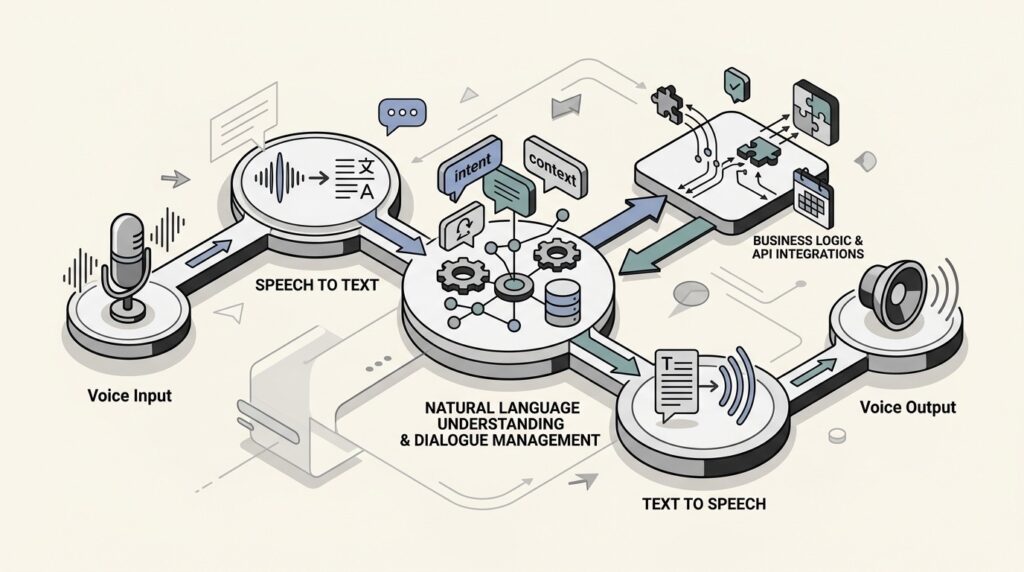
    The typical pipeline looks like this: voice activity detection identifies when someone is speaking, speech-to-text converts the audio to text, a language model processes the meaning, and text-to-speech generates the response. In an on-device deployment, all of these steps happen locally.

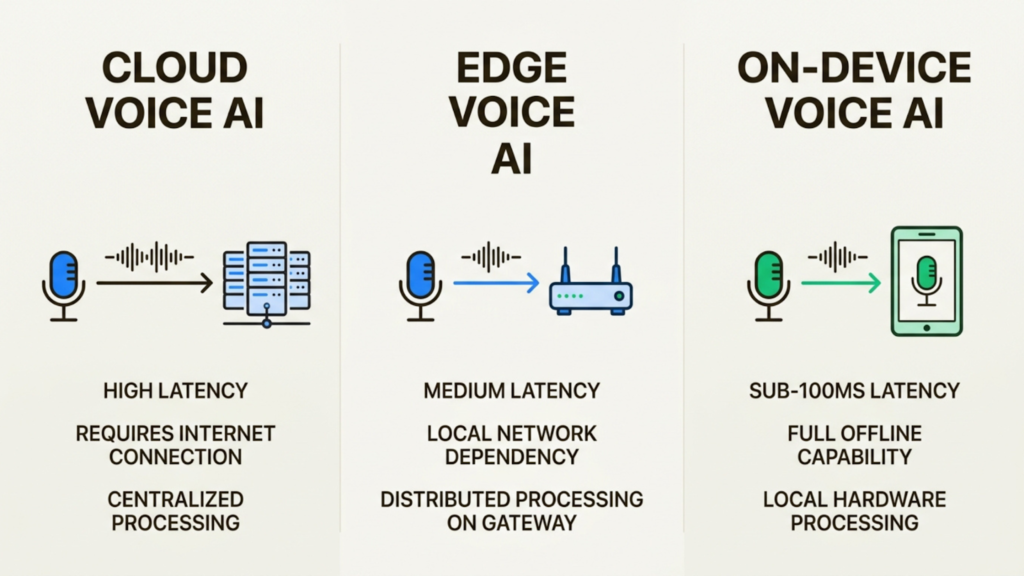
    This is different from edge deployment, where processing happens on a nearby server or gateway, and cloud deployment, where audio travels to distant data centers. On-device is the most private and lowest-latency option because data never leaves the hardware it was captured on.

    The shift toward on-device processing is happening because of specialized neural processing units in consumer hardware, the development of smaller and more efficient AI models, and growing enterprise requirements for data privacy and compliance.

    Why Enterprises Are Moving Voice AI To The Edge

    The move toward on-device and edge deployment is not just about technology. It addresses specific operational requirements that matter to businesses.

    Latency that feels instant

    Cloud round trips add delay. Even fast connections introduce 100-300 milliseconds of latency, and complex multi-model systems compound this. For real-time applications like voice agents in contact centers, every millisecond matters.

    On-device processing eliminates network round trips entirely. Leading solutions achieve sub-1000ms response times. At Shunya Labs, our streaming ASR operates under 100ms for real-time applications. This makes conversations feel natural rather than robotic.

    Privacy by design

    When voice data leaves the device, it creates exposure. GDPR, HIPAA, and other regulations require strict controls over personal data. Healthcare organizations cannot send patient conversations to third-party clouds. Financial services face similar constraints.

    On-device processing keeps data local by default. It never traverses networks or sits on external servers. This makes compliance simpler and reduces the attack surface for data breaches.

    Reliability in any environment

    Cloud-dependent systems fail when connectivity drops. This is unacceptable for mission-critical applications like in-vehicle voice commands, field operations in remote areas, or industrial IoT sensors.

    Edge and on-device deployments operate independently of network conditions. They process and store data locally, syncing when connectivity returns. This ensures continuity in harsh or disconnected environments.

    Cost efficiency at scale

    Streaming high-resolution audio from thousands of devices generates significant bandwidth and cloud infrastructure costs. On-device processing eliminates these recurring expenses, making large-scale deployments economically viable.

    Technical Approaches For Edge Optimization

    Running AI on resource-constrained devices requires specialized techniques. Raw models designed for cloud data centers are too large and slow for edge hardware.

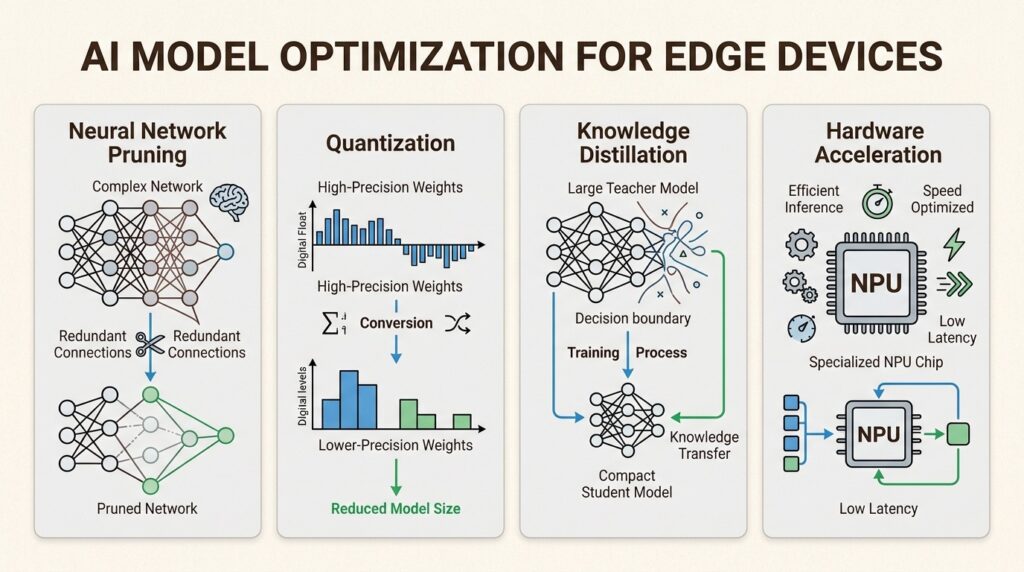
    Model compression

    Compression reduces model size so it fits within limited memory. Techniques include pruning, which removes redundant neurons or weights, and quantization, which converts models from 32-bit floating point to 8-bit or lower precision.

    These techniques can shrink models by 50-90% while maintaining acceptable accuracy. A voice assistant on a smart speaker can answer quickly because the model is small enough to run locally.

    Knowledge distillation

    Distillation trains a small model to mimic a larger, more complex one. The smaller student model learns from the larger teacher model, keeping accuracy high while using fewer resources.

    This approach works well for conversational applications where you need quality responses without cloud dependency.

    Frameworks and hardware acceleration

    Developers use TensorFlow Lite, ONNX Runtime, CoreML, and OpenVINO to deploy models across platforms. Modern hardware includes neural processing units like the Apple Neural Engine, Qualcomm Hexagon, and Google Tensor cores that accelerate inference.

    The multi-language challenge

    Supporting 200+ languages on edge devices is technically demanding. Each language requires acoustic and linguistic models, and combining them increases memory requirements. Code-switching, where speakers alternate between languages mid-sentence, adds additional complexity.

    Most edge voice AI solutions prioritize major languages like English, Spanish, and Mandarin. Support for Indic languages and mixed-language conversations remains limited.

    Real-World Use Cases For On-Device Voice AI

    The applications for edge voice AI span industries and use cases.

    Contact centers

    Real-time agent assistance requires sub-100ms latency to avoid interrupting natural conversation flow. On-device processing provides immediate transcription and suggestion generation without sending sensitive customer data to external servers.

    Healthcare

    Clinical documentation must comply with HIPAA and other regulations. On-device speech recognition lets clinicians dictate notes without exposing patient information to cloud services. Our model is specifically optimized for medical terminology and clinical workflows.

    Automotive

    Voice commands for navigation, climate control, and entertainment should work in tunnels, remote highways, or areas with poor cellular coverage. Edge processing ensures functionality regardless of connectivity.

    IoT and smart devices

    Smart speakers, appliances, and industrial sensors benefit from local voice control. Commands execute instantly without cloud dependency, and privacy concerns are minimized.

    Field operations

    Workers in mining, agriculture, and construction often operate in areas without reliable connectivity. On-device voice interfaces let them interact with systems, log data, and receive instructions without needing network access.

    How Shunya Labs Approaches Voice AI

    Most voice AI providers focus on cloud deployment. Those offering edge options typically support a limited language set, often centered on English and major European languages. This leaves significant gaps for global enterprises.

    We built our Zero STT Suite specifically for deployment flexibility and multilingual support.

    The Zero STT Suite

    Our foundation models cover the full range of speech recognition needs:

    ModelPurposeKey Features
    Zero STTGeneral-purpose STT200+ languages, streaming support
    Zero STT IndicIndian languages32+ Indic languages, regional accents
    Zero STT CodeswitchMixed-language speechNative code-switching support
    Zero STT MedHealthcareHIPAA-compliant, medical terminology

    Language coverage that matches the real world

    We support 200+ languages including 32+ Indic languages. This is not just about translation. Our models understand regional accents, dialects, and the way people actually speak, including code-switching between languages.

    For example, our Zero STT Codeswitch model handles Hinglish (Hindi + English), and other common language pairs natively. This is critical for markets like India, where mixed-language speech is the norm rather than the exception.

    Flexible deployment options

    We offer three deployment modes to match your requirements:

    DeploymentBest ForData Handling
    Cloud APIRapid prototyping, variable workloadsProcessed in our SOC 2 Type II certified infrastructure
    EdgeLow-latency requirements, bandwidth constraintsProcessed on your edge hardware
    Self-hosted/On-premisesStrictest compliance, air-gapped environmentsFully contained within your infrastructure

    Enterprise-grade security

    Our platform maintains certifications that enterprises require. We are SOC 2 Type II certified, ISO/IEC 27001:2022 accredited, and HIPAA compliant. Our two-sided encryption uses both TLS and AES-256 to protect data at rest and in transit.

    Deploy Voice AI On Your Terms With Shunya Labs

    On-device voice AI deployment is moving from niche applications to mainstream enterprise infrastructure. The benefits are clear: sub-100ms latency, enhanced privacy, offline operation, and reduced bandwidth costs.

    The challenge has been finding solutions that support the languages your users actually speak. Most edge voice AI is built for English-first markets. If your users speak Hindi, Tamil, Bengali, or switch between languages mid-sentence, you may have been poorly served by the market.

    We built Shunya Labs to solve this. Whether you need cloud API access for rapid development, edge deployment for latency-sensitive applications, or full on-premises installation for compliance, we have you covered.If you are evaluating voice AI for contact centers, healthcare, automotive, or IoT applications, contact us here. Our team can assess your requirements and recommend the right deployment architecture for your use case.

  • Essential Voice Security Measures For Enterprise AI In 2026

    Essential Voice Security Measures For Enterprise AI In 2026

    Voice AI has become critical infrastructure. The technology now powers healthcare documentation, financial services, and contact center automation. The global voice AI market is projected to reach $32.47 billion by 2030.

    This growth brings security from a procurement checkbox to a board-level concern. Voice data is fundamentally different from text. It contains biometric identifiers, unstructured personal information, and content that is harder to monitor and filter. When a breach happens, the damage extends far beyond regulatory fines.

    This guide breaks down the essential voice security measures every enterprise needs to implement.

    Why Voice AI Security Demands A Different Approach

    Voice data is not like other data. When someone speaks, they share more than just words. Voice recordings capture biometric identifiers that can uniquely identify individuals. They contain unstructured personal information (names, addresses, health details, financial data) that flows naturally in conversation. Unlike typed input, voice is harder to scan and filter in real time.

    The regulatory landscape reflects this uniqueness. Under General Data Protection Regulation (GDPR), voice biometrics qualify as special category data requiring explicit consent. The Federal Communications Commission (FCC) has clarified that AI-generated voices require prior written consent under the Telephone Consumer Protection Act. Illinois’ Biometric Information Privacy Act (BIPA) imposes strict requirements on voiceprint collection.

    The cost of getting this wrong is substantial. IBM’s 2024 Cost of a Data Breach Report found the average breach costs $4.88 million. For AI-related breaches specifically, that figure rises to $4.9 million. According to Salesforce research, 73% of business leaders worry that generative AI may introduce new security vulnerabilities. Pindrop’s 2025 Voice Intelligence and Security Report estimates $12.5 billion was lost to contact center fraud in 2024 alone.

    Traditional security models were built for text and structured data. They do not account for the unique risks of voice: biometric identification, adversarial audio attacks, and the unstructured nature of spoken content. Voice AI security requires a fundamentally different architecture.

    Core Security Architecture For Voice AI Systems

    Encryption In Transit And At Rest

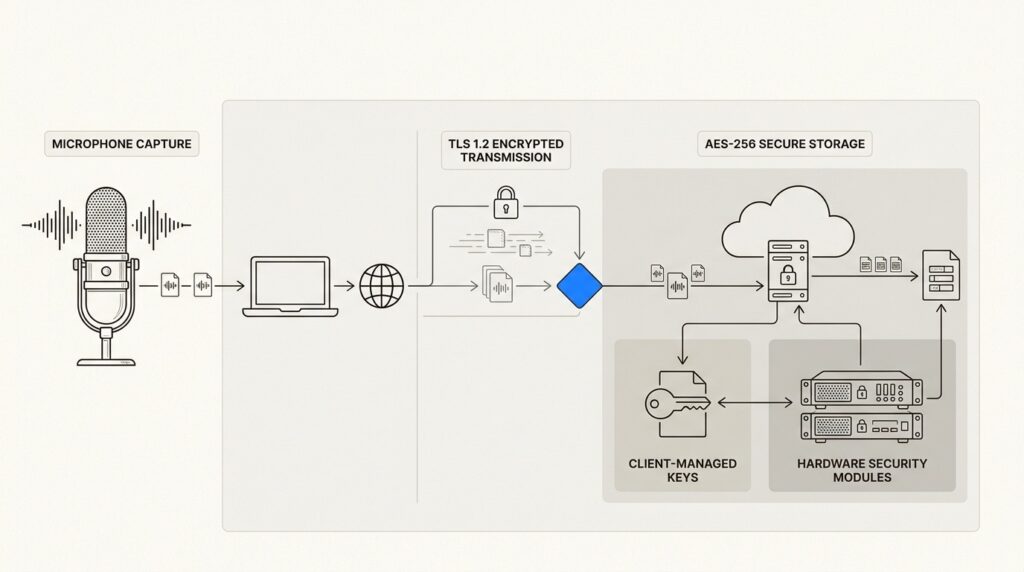
    Every piece of voice data should be encrypted throughout its lifecycle. For voice streams in transit, this means TLS 1.2 or higher. For stored recordings and transcripts, AES-256 encryption is the standard.

    End-to-end encryption (E2EE) ensures voice audio and transcripts remain encrypted from capture until they reach a trusted endpoint. This prevents intermediaries from accessing plaintext even if network segments are compromised. Implementing E2EE requires careful key management. Hardware Security Modules (HSMs) provide tamper-resistant storage for encryption keys in high-security environments.

    At Shunya Labs, data is encrypted in transit and at rest: TLS for every connection, AES-256 for storage, with keys managed in your cloud, giving enterprises full control over their encryption infrastructure.

    Authentication And Access Control

    Not everyone needs access to everything. Role-based access control (RBAC) assigns permissions based on job functions. A support technician might only need access to basic transcript logs. An administrator requires broader access for auditing. The principle of least privilege reduces the chance of internal misuse or accidental exposure.

    Multi-factor authentication (MFA) should protect all administrative access to voice AI systems. Common second factors include time-based one-time passwords (TOTP), push notifications, and hardware tokens. Voice-only authentication should never be the sole MFA mechanism because synthetic voice attacks can spoof single-factor voice prompts.

    For voice biometric systems, liveness detection is essential. This technology verifies that a presented voice sample originates from a live human rather than a replayed recording or synthetic audio. Active liveness requires user interaction (speaking a randomized phrase). Passive liveness analyzes audio characteristics for natural inconsistencies.

    Network And Infrastructure Security

    Voice AI systems should operate within secure network boundaries. IP allowlisting restricts access to known addresses. VPN requirements ensure encrypted tunnels for remote access. Webhook signature verification prevents unauthorized systems from sending data to your endpoints.

    Geographic redundancy across data centers ensures availability even during regional outages. Automatic failover mechanisms maintain service continuity. Real-time monitoring and anomaly detection catch unusual access patterns, failed authentication attempts, and unexpected changes in data routing.

    Compliance Frameworks Every Enterprise Must Address

    Gdpr And Data Privacy Regulations

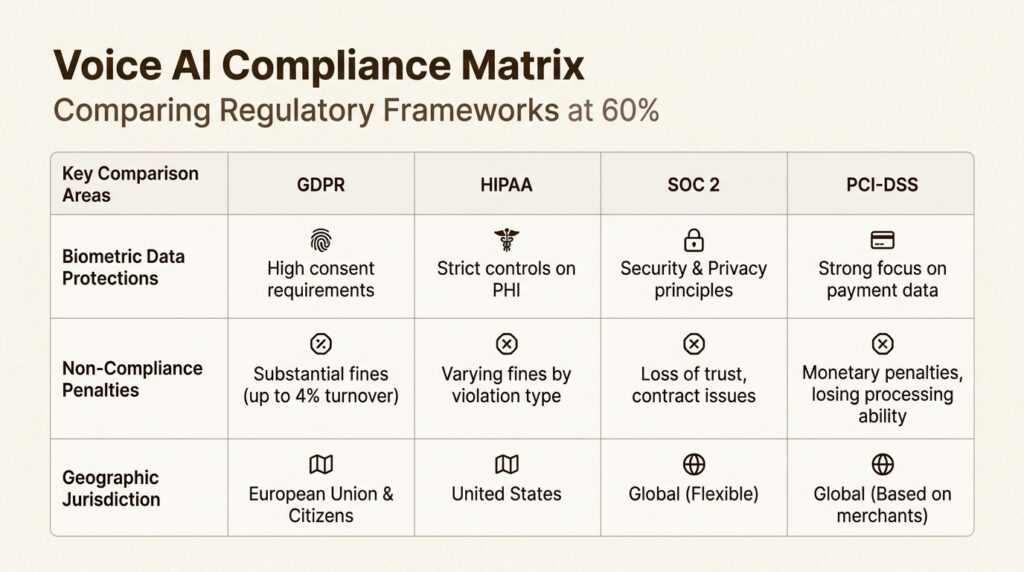
    The General Data Protection Regulation treats voice data as personal data. When used for identification, voice biometrics become special category data under Article 9, requiring explicit consent and enhanced protections.

    Enterprises must establish a lawful basis for processing voice recordings. This could be explicit consent with opt-in mechanisms, legitimate interest with documented balancing tests, or contractual necessity. Data Protection Impact Assessments are required when processing voice at scale.

    Users have the right to access their voice data, request corrections, and demand erasure. Organizations must respond to these requests within GDPR’s 30-day timeline. This requires auditable workflows for locating and deleting specific voice recordings across storage systems.

    Industry-Specific Compliance

    Healthcare organizations must comply with HIPAA’s Security Rule for electronic protected health information (e-PHI). Voice recordings containing PHI must be encrypted at rest and in transit. Business Associate Agreements (BAAs) are required with voice AI vendors. The HHS Office for Civil Rights provides educational guidance on implementing these safeguards.

    For payment card data, PCI-DSS requires automatic redaction and tokenization. Voice AI systems handling transactions must detect and mask card numbers in real time.

    SOC 2 Type II certification demonstrates that a voice AI vendor maintains comprehensive security controls over time. ISO 27001 certification indicates a robust information security management system.

    For enterprises operating in India, the Digital Personal Data Protection Act 2023 establishes consent requirements and data fiduciary obligations. Voice data qualifies as personal data under the Act. Significant data fiduciaries face additional compliance obligations including Data Protection Officer appointment.

    Telecommunications And Biometric Laws

    The FCC confirmed in 2024 that AI-generated voices require prior express written consent under the Telephone Consumer Protection Act (TCPA). Violations carry statutory damages up to $1,500 per call.

    Illinois’ Biometric Information Privacy Act (BIPA) requires written consent before collecting voiceprints, publicly available retention schedules, and prohibits selling biometric data. Private individuals can sue for violations, making compliance essential.

    California’s CCPA and CPRA grant consumers rights to know what voice data is collected, opt out of sale, and request deletion. Similar laws are spreading across US states.

    Emerging Threats And How To Counter Them

    Deepfake And Synthetic Voice Attacks

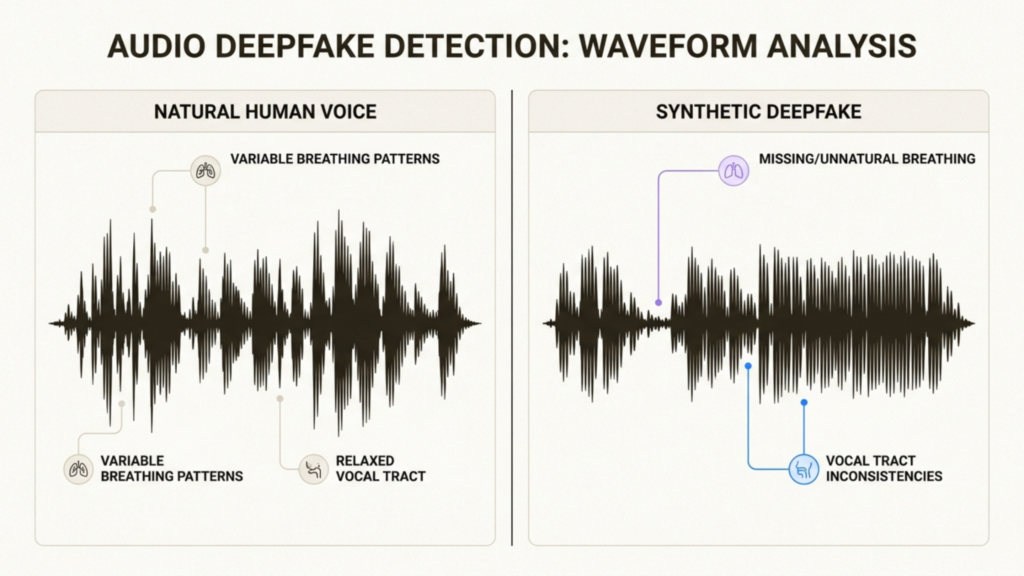
    Deepfake fraud attempts rose over 1,300% in 2024, jumping from an average of one per month to seven per day according to Pindrop research. Attackers use minimal audio samples to create convincing voice replicas that bypass traditional authentication.

    Anti-spoofing algorithms analyze voice characteristics difficult to replicate: breathing patterns, vocal tract characteristics, and other biometric markers. Multi-layered authentication combining voice with additional factors creates more robust protection.

    Adversarial Audio Attacks

    Researchers have demonstrated that attackers can craft audio containing hidden commands inaudible to humans but recognized by AI systems. The “DolphinAttack” technique uses ultrasonic frequencies to issue commands without victims’ knowledge.

    Defending against these attacks requires adversarial training of voice models, input preprocessing to detect anomalies, and anomaly scoring systems that flag suspicious audio patterns.

    Vishing and social engineering

    Voice-based phishing (vishing) targets employees with calls impersonating banks, tech support, or colleagues. With generative AI, these attacks sound increasingly authentic.

    Defense requires employee training on verification protocols: never sharing sensitive information without confirming identity through official channels, hanging up and calling back at verified numbers, and reporting suspicious calls immediately.

    Deployment Strategies For Maximum Security

    Cloud Deployment Security

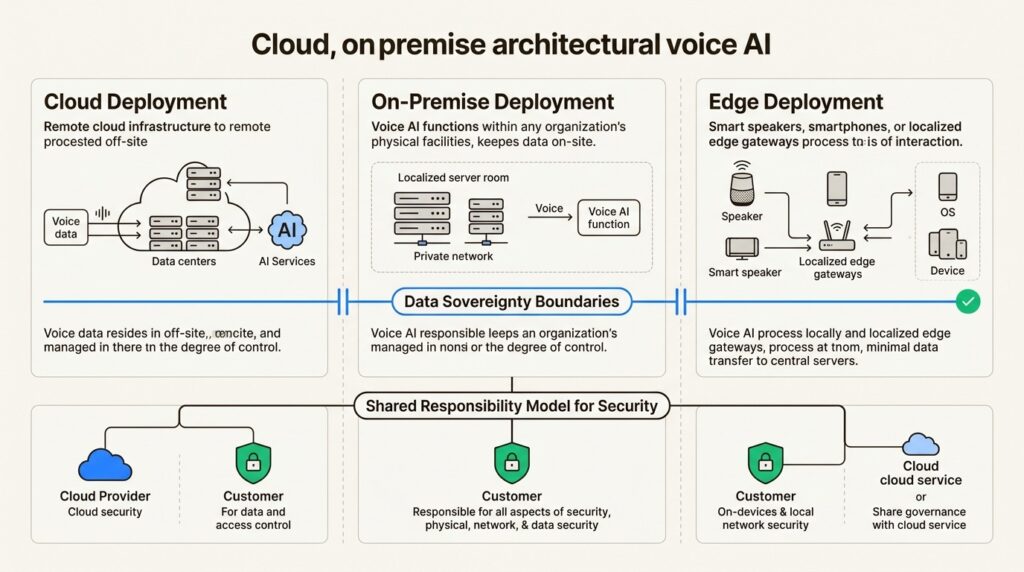
    Cloud deployments follow a shared responsibility model. The provider secures the infrastructure. The customer secures their data and configurations. Enterprises must verify cloud providers maintain SOC 2 Type II, ISO 27001, and relevant compliance certifications.

    Data residency controls ensure voice data remains in specified geographic regions. This is critical for compliance with data sovereignty requirements in the EU, India, and other jurisdictions.

    On-Premise And Edge Deployment

    For maximum control, on-premise deployments keep voice data within enterprise infrastructure. Air-gapped environments provide the highest security for sensitive applications. Edge processing handles voice data locally on devices, reducing exposure during transmission.

    On-device processing is especially valuable in healthcare, finance, and government applications where data cannot leave the premises. Latency is reduced and compliance simplified when voice processing happens at the edge.

    Hybrid And Multi-Cloud Considerations

    Many enterprises use hybrid approaches combining cloud and on-premise resources. Consistent security policies must apply across all environments. API security becomes critical as voice data flows between systems. Centralized monitoring provides visibility into the entire voice AI infrastructure.

    At Shunya Labs, we offer deployment flexibility to match your security requirements: cloud API for rapid deployment, local deployment for data sovereignty, and on-premise/edge options for maximum control.

    Building Your Voice Ai Security Roadmap

    Implementing voice AI security is a phased process:

    Step 1: Inventory voice data flows. Map where voice data is captured, processed, stored, and transmitted. Identify all systems that touch voice recordings.

    Step 2: Map compliance requirements. Determine which regulations apply based on your industry and geographic presence. Healthcare needs HIPAA. EU operations need GDPR. Contact centers need TCPA compliance.

    Step 3: Implement encryption and access controls. Deploy TLS 1.2+ for transit, AES-256 for storage, RBAC for access management, and MFA for administrative accounts.

    Step 4: Deploy monitoring and anomaly detection. Implement logging, real-time monitoring, and alerting for suspicious access patterns.

    Step 5: Establish incident response procedures. Create playbooks for voice data breaches. Define notification timelines and remediation steps.

    Step 6: Regular audits and penetration testing. Schedule periodic security assessments. Test defenses against emerging threats like deepfakes and adversarial audio.

    Secure Your Voice AI With Shunya Labs

    Voice AI security is not optional. The regulatory requirements are clear. The threat landscape is evolving. The cost of failure is measured in millions of dollars and irreparable reputation damage.

    At Shunya Labs, we built enterprise security from day one. Our platform offers:

    • SOC 2 Type II, ISO 27001, and HIPAA compliance for regulated industries
    • Two-sided encryption with TLS in transit and AES-256 at rest, plus client-managed keys
    • Deployment flexibility across cloud, on-premise, and edge environments
    • 32+ Indic language support with code-switching capabilities for regional compliance
    • FHIR and HL7 structured outputs for healthcare integration

    Whether you are processing millions of customer service calls or transcribing sensitive medical consultations, your voice data deserves enterprise-grade protection.

    Ready to secure your voice AI deployment? Contact our team to discuss your security requirements and see how Shunya Labs can help you implement voice AI on your terms.

  • How To Integrate Speech-To-Text API In 2026: A Developer’s Guide

    How To Integrate Speech-To-Text API In 2026: A Developer’s Guide

    Voice interfaces aren’t optional anymore. They’re what users expect. Whether you’re building a voice assistant, adding live captions to a video platform, or automating call center transcription, speech-to-text (STT) APIs are the foundation.

    But there’s a difference between making an API work and integrating it well. Production-ready code requires understanding nuances that separate prototypes from reliable systems. This guide walks you through integrating STT APIs in 2026. We’ll cover provider selection, authentication patterns, streaming versus batch processing, and error handling strategies that keep your application running when things go sideways.

    What you’ll need before starting

    Before writing any code, make sure you have the basics in place:

    • API credentials from your chosen provider (most require signup and credit card verification)
    • Audio capture capability (microphone access for real-time, file upload for batch)
    • Development environment with Python 3.8+ or Node.js 16+ installed
    • HTTP client (requests for Python, axios/fetch for JavaScript)
    • Basic understanding of REST APIs and WebSocket connections

    Some providers offer free tiers or trial credits. Visit shunyalabs.ai to know more.

    Step 1: Choose your STT provider and get API credentials

    Not all STT APIs are built for the same use cases. Here’s how the major players compare for integration purposes:

    ProviderBest ForLatencyLanguagesStarting Price
    DeepgramReal-time voice agents~298ms36+$0.0043/min
    OpenAI WhisperBatch transcription, multilingualN/A (batch)99+$0.006/min
    Google CloudEnterprise GCP environments~420ms125+$0.024/min
    Shunya LabsIndic languages, healthcare<250ms200+ (55+ Indic)Contact sales

    Let’s break down when to choose each provider.

    When to choose Deepgram

    Pick Deepgram if you’re building real-time applications like voice agents or live captioning. Their Nova-3 model achieves 5.26% Word Error Rate with sub-300ms latency. They also offer a unified Voice Agent API. This single endpoint handles STT, LLM orchestration, and TTS together.

    When to choose OpenAI Whisper

    Pick OpenAI Whisper if you need high-accuracy batch transcription across many languages. It’s the accuracy benchmark for multilingual content. The tradeoff is no native streaming support. You’ll need to implement chunking for real-time use cases.

    When to choose Google Cloud

    Pick Google Cloud if you’re already embedded in the Google ecosystem. The Chirp 3 model offers solid performance, but latency is higher than specialists. This option works best when ecosystem integration matters more than raw speed.

    When to choose Shunya Labs

    Pick Shunya Labs if you’re building for Indian markets or need Indic language support. Zero STT suite handles code-switching (mixing English with Hindi, Tamil, etc.) and offers sub-250ms latency. Shunya Labs also has HIPAA-compliant deployment for healthcare use cases.

    Once you’ve selected a provider, sign up and generate an API key. Store it securely using environment variables. Never hardcode credentials. Test connectivity with a simple request before building your full integration.

    Step 2: Set up your development environment

    With your API key in hand, install the necessary dependencies.

    For Python:

    pip install requests python-dotenv

    pip install deepgram openai google-cloud-speech

    For Node.js:

    npm install axios dotenv

    Create a .env file to store your credentials:

    SHUNYA_API_KEY=your_key_here

    Load these in your application:

    from dotenv import load_dotenv

    import os

    load_dotenv()

    For audio capture, you’ll need additional setup depending on your use case:

    • File input: No extra dependencies
    • Microphone input: pyaudio (Python) or navigator.mediaDevices (browser)
    • Phone/streaming: WebSocket client library

    Step 3: Implement batch transcription for recorded audio

    Batch transcription is the simplest integration pattern. You send a complete audio file to the API. You receive a transcript when processing completes.

    Key considerations for batch processing:

    • File size limits: OpenAI caps at 25 MB. Google Cloud supports up to 480 minutes via async API.
    • Audio format: 16kHz mono PCM is the safest bet across providers. MP3 works but introduces compression artifacts.
    • Response time: Batch processing can take seconds to minutes depending on file length and provider load.

    Step 4: Implement real-time streaming transcription

    Real-time transcription uses WebSocket connections to stream audio chunks as they’re captured. This approach enables sub-300ms response times. These speeds are essential for voice agents and live captioning.

    Critical implementation details for streaming:

    • Interim vs final results: Display interim transcripts as “pending” (they may change). Only commit final transcripts to your database.
    • Buffer size: Send audio in 250ms chunks for optimal latency.
    • Endpointing: Configure voice activity detection to identify speech boundaries.
    • Reconnection: Implement graceful reconnection logic for network interruptions.

    Step 5: Handle errors, retries, and edge cases

    Production STT integrations fail in predictable ways. Here’s how to handle them.

    Network timeouts

    import time

    from requests.adapters import HTTPAdapter

    from requests.packages.urllib3.util.retry import Retry

    def requests_retry_session(

        retries=3,

        backoff_factor=0.3,

        status_forcelist=(500, 502, 503, 504)

    ):

        session = requests.Session()

        retry = Retry(

            total=retries,

            read=retries,

            connect=retries,

            backoff_factor=backoff_factor,

            status_forcelist=status_forcelist,

        )

        adapter = HTTPAdapter(max_retries=retry)

        session.mount(‘http://’, adapter)

        session.mount(‘https://’, adapter)

        return session

    Rate limiting

    Most providers return 429 status codes when you exceed quota. Implement exponential backoff and queueing for high-volume applications.

    Audio format errors

    Validate audio before sending:

    • Check sample rate (16kHz recommended)
    • Verify mono vs stereo (mono typically performs better)
    • Ensure file isn’t corrupted

    Empty transcripts

    Not all audio contains speech. Handle empty responses gracefully rather than throwing errors.

    Dead letter queue

    For batch processing, implement a DLQ for files that consistently fail. These usually indicate malformed audio that needs manual inspection.

    Step 6: Optimize for production

    Once your integration works, optimize for accuracy, cost, and reliability.

    Audio preprocessing

    • Apply noise suppression before sending (client-side if possible)
    • Normalize audio levels
    • Use 16kHz sample rate minimum
    • Prefer lossless formats (FLAC, PCM) over compressed (MP3)

    Custom vocabulary

    Boost recognition for domain-specific terms:

    options = {

        “keywords”: [“ZyntriQix:5”, “Digique Plus:3”],  # word:boost_factor

        “model”: “nova-3”

    }

    Cost optimization

    • Use batch processing for recorded content (cheaper per minute)
    • Implement silence detection to skip empty audio
    • Cache transcripts for repeated content
    • Compress audio intelligently (OPUS at 48kbps is acceptable)

    Monitoring

    Track these metrics in production:

    • Word Error Rate on your test set
    • API latency (p50, p95, p99)
    • Cost per hour of audio
    • Error rates by error type

    Integrating Indic languages and code-switching

    Standard STT APIs struggle with Indian languages. They also have difficulty with code-switching, which is switching between English and regional languages mid-sentence. If your application serves Indian markets, you need specialized handling.

    Shunya Labs Zero STT Indic supports 55+ Indic languages. This includes dialects like Awadhi, Bhojpuri, and Haryanvi that global providers often miss. Zero STT Codeswitch model trains specifically on mixed-language speech patterns. These patterns are common in Indian conversations.

    Healthcare applications

    For healthcare applications, Shunya Labs offers Zero STT Med. This includes HIPAA-compliant deployment options and clinical terminology optimization. Medical transcription requires both accuracy and compliance. Generic APIs don’t provide these features.

    Why specialized providers matter

    Global APIs treat Indic languages as an afterthought. Specialized providers build their models on native speaker data. The accuracy gap is significant. For Indian market applications, the specialized route isn’t just preferable. It’s necessary.

    Start building voice features today

    Integrating speech-to-text APIs in 2026 is straightforward. However, it requires attention to details that separate working code from production-ready systems.

    Start with batch processing to validate your use case. Then add streaming when you need real-time responses. Test with your actual audio samples, not just clean test files. Build abstraction layers so you can switch providers as the market evolves.

    The providers covered here represent the current state of the art. Each has strengths for specific use cases. Choose based on your latency requirements, language needs, and existing infrastructure.If you’re building for Indian markets or need Indic language support, our Zero STT suite provides the specialized capabilities. We handle code-switching, dialect variations, and offer deployment options that satisfy data residency requirements. Contact us for API access and integration support.

  • What Is A Voice AI Agent? How Conversational AI Works End To End

    What Is A Voice AI Agent? How Conversational AI Works End To End

    Phone support is still one of the most critical channels in customer service. It is expensive to staff, hard to scale, and often leads to frustrating experiences for both customers and agents. Long hold times, robotic interactions, and endless repetition have become the norm.

    But something is changing. Voice AI agents are experiencing a renaissance. Voice is used in 82% of all customer interactions, up from 77% just a year ago (Metrigy Customer Experience Optimization: 2025-26). The market for voice and speech recognition technology is projected to grow from $14.8 billion in 2024 to over $61 billion by 2033.

    This is not just about replacing phone trees with slightly better automation. Modern voice AI agents can understand natural speech, process meaning, and respond conversationally. They can handle complex workflows, integrate with business systems, and hand off to humans when needed.

    In this guide, we will break down exactly how voice AI agents work, from the moment a caller speaks to the moment the agent responds. We will explore the architecture, the use cases, and the business value. And we will look at what it takes to build voice AI that actually works in production.

    What Is a Voice AI Agent?

    A voice AI agent is an intelligent, speech-driven system that can understand natural language, determine intent with context, and complete tasks in real time. Think of it as a skilled receptionist that never misses a call, responds instantly, and maintains full awareness of the conversation.

    Unlike traditional interactive voice response (IVR) systems that force callers through rigid menu trees (“Press 1 for sales, Press 2 for support”), voice AI agents understand natural speech. A caller can say “I need to reschedule my appointment” or “My order never arrived” and the agent understands what they want.

    Here is what a voice AI agent can do:

    • Interpret caller requests expressed in natural language, identifying whether the person is trying to reschedule an appointment, ask a question, or escalate an issue
    • Access business systems required to complete the task, including calendars, CRM platforms, electronic health records, or billing tools
    • Carry out operational tasks from start to finish, such as booking appointments, qualifying leads, or checking policy details
    • Route callers based on true conversational intent, sending them directly to the right team member instead of forcing them through menu-based navigation
    • Document every interaction as structured data, capturing intent, sentiment, outcomes, and follow-up requirements

    The leap in capability reflects a broader shift in customer engagement. Voice is not going away. In fact, it is becoming more essential as businesses realize that phone interactions remain the preferred channel for urgent, complex, or critical issues.

    The Core Architecture: How Voice AI Works End to End

    From the caller’s perspective, the interaction is simple: they speak, and the agent responds. Behind that simplicity is a layered process that blends multiple technologies into a seamless pipeline.

    Let’s break down the core architecture that makes this possible.

    Speech Recognition (ASR)

    Every voice interaction starts with automatic speech recognition (ASR). This component converts spoken audio into text that the system can process.

    Modern ASR systems have come a long way from the rigid voice recognition of the past. Today’s systems can:

    • Transcribe different accents and speech patterns at high accuracy (top systems achieve word error rates as low as 3.1%)
    • Handle background noise and challenging audio environments
    • Process speech in real time with minimal delay
    • Support multiple languages and even detect language switches mid-conversation

    The quality of your ASR layer directly impacts everything downstream. A 95% accurate system produces 5 errors per 100 words. An 85% accurate system produces 15 errors per 100 words. That difference determines whether your voice AI feels helpful or frustrating.

    Language Understanding (LLM)

    Once speech becomes text, a large language model (LLM) figures out what the user actually wants. This goes far beyond simple keyword matching.

    The LLM handles:

    • Intent detection: Determining whether the caller wants to book an appointment, check an order status, or file a complaint
    • Entity extraction: Pulling out specific details like dates, names, order numbers, or policy types
    • Context management: Remembering information shared earlier in the conversation so callers do not have to repeat themselves
    • Reasoning: Working through complex requests that require multiple pieces of information or conditional logic

    This is where modern voice AI diverges from older systems. Traditional IVR could only handle rigid commands. Today’s LLM-powered agents can follow complex conversations, remember context from earlier exchanges, and respond to interruptions or changes in topic.

    Text-to-Speech (TTS)

    The final component transforms the agent’s text response back into spoken words. Text-to-speech technology has evolved to create voices that capture natural rhythm, emphasis, and emotion.

    Advanced TTS systems can:

    • Match tone to the emotional state of the conversation
    • Use appropriate pacing and pauses for clarity
    • Pronounce industry-specific terminology correctly
    • Switch voices or languages mid-conversation when needed

    The goal is not just to sound human, but to sound appropriate for the context. A healthcare voice agent should sound calm and reassuring. A sales agent might be more upbeat and energetic.

    The Orchestration Layer

    Beyond the core speech components, a production voice AI needs an orchestration layer that manages the conversation flow. This layer:

    • Chooses the best resolution path based on intent
    • Connects to business systems via APIs (CRM, ticketing, scheduling, billing)
    • Handles error recovery when something goes wrong
    • Decides when to escalate to a human agent
    • Maintains conversation state across multiple turns

    Without solid orchestration, even the best speech recognition and language models produce disjointed, frustrating experiences.

    Latency Requirements

    One factor that binds all these components together is latency. For a conversation to feel natural, the agent must respond within 250 milliseconds. Anything longer creates awkward pauses that break the conversational flow.

    Achieving sub-250ms latency requires careful optimization across the entire pipeline: fast ASR, efficient LLM inference, streaming TTS, and minimal network overhead.

    Three Architectural Approaches Compared

    While the cascading model (ASR → LLM → TTS) is common, it is not the only way to build a voice agent. The architecture you choose impacts everything from latency to conversational flexibility.

    Cascading Architecture

    The traditional approach uses a series of independent models: speech-to-text, then a language model for understanding, then text-to-speech for the response.

    Strengths:

    • Modular and easier to debug
    • High control and transparency at each step
    • Robust function calling and structured interactions
    • Reliable, predictable responses

    Best for: Structured workflows, customer support scenarios, sales and inbound triage

    Trade-offs: The handoffs between components can add latency, sometimes making conversations feel slightly delayed.

    End-to-End Architecture

    This newer approach uses a single, unified AI model to handle the entire process from incoming audio to spoken response. OpenAI’s Realtime API with gpt-4o-realtime-preview is an example of this approach.

    Strengths:

    • Lower latency interactions
    • Rich multimodal understanding (audio and text simultaneously)
    • Natural, fluid conversational flow
    • Captures nuances like tone and hesitation better than cascading systems

    Best for: Interactive and unstructured conversations, language tutoring, conversational search and discovery

    Trade-offs: More complex to build and fine-tune. Less transparent since you cannot inspect the intermediate text representations.

    Hybrid Architecture

    A hybrid approach combines the best of both worlds. It might use a cascading system for its robust, predictable logic but switch to an end-to-end model for more fluid, open-ended parts of a conversation.

    Strengths:

    • Optimizes for both performance and capability
    • Can use cascading for structured tasks and end-to-end for natural conversation
    • More flexible than either pure approach

    Best for: Complex applications that need both reliability and conversational flexibility

    ArchitectureLatencyControlBest For
    CascadingHigherHighStructured workflows, support
    End-to-EndLowerMediumFluid conversations, tutoring
    HybridMediumHighComplex, multi-modal applications

    Real-World Use Cases and Applications

    Voice AI agents have moved beyond novelty to become practical business tools across every industry. Here are the key applications delivering measurable results.

    Customer Support Automation

    The most common use case is handling tier-1 support calls without wait times. Voice AI agents can:

    • Answer common questions using knowledge base articles
    • Troubleshoot basic issues through guided conversations
    • Process returns, refunds, and account changes
    • Create and update support tickets with full context
    • Escalate complex issues to human agents with conversation summaries

    In some implementations, AI agents now manage as much as 77% of level 1 and level 2 client support.

    Appointment Scheduling

    Healthcare clinics, salons, and service businesses use voice AI to handle scheduling without staff involvement:

    • Book appointments across multi-provider calendars
    • Handle rescheduling and cancellations
    • Send reminders and confirmations
    • Collect pre-visit information
    • Route urgent requests to appropriate staff

    Sales and Lead Qualification

    For sales organizations, inbound voice interactions are often time-sensitive. Voice AI agents can:

    • Ask predefined questions to qualify leads
    • Route qualified leads to the appropriate sales team
    • Capture key information for follow-ups
    • Log call summaries into connected CRM systems
    • Provide 24/7 coverage for after-hours inquiries

    Healthcare Coordination

    Healthcare organizations have specific requirements around compliance and accuracy. Voice AI agents in healthcare can:

    • Manage appointment scheduling and reminders
    • Conduct pre-visit questionnaires
    • Provide medication reminders
    • Route urgent medical concerns to appropriate staff
    • Maintain HIPAA compliance throughout interactions

    Internal Operations

    Voice AI is not just for customer-facing use cases. Internal applications include:

    • Hands-free access to manuals and documentation for field technicians
    • Inventory management and parts ordering
    • Time tracking and work logging
    • Equipment status checks
    • Safety reporting

    Business Benefits and ROI

    The business case for voice AI agents goes beyond cost reduction. When implemented correctly, they transform operations across multiple dimensions.

    Operational Efficiency

    Voice AI agents deliver three key operational advantages:

    • 24/7 availability: Provide instant support to customers in any time zone without increasing headcount
    • Reduced handling time: Automate data collection and initial troubleshooting to resolve issues faster
    • Lower operational costs: Decrease reliance on large contact center teams for routine support

    Businesses implementing automation see ROI improvements ranging from 30% to 200% in the first year.

    Customer Experience

    Long wait times and inconsistent service are major sources of customer frustration. Voice AI agents address these pain points directly:

    • No more wait times: Instantly answer incoming calls, eliminating frustrating queues
    • Consistent information: Ensure every customer receives standardized, correct information pulled directly from your knowledge base
    • Personalized interactions: Use data from your CRM to greet customers by name and understand their history

    Automating workflows can improve customer satisfaction by nearly 7%.

    Business Scalability

    As your business grows, so does the volume of customer interactions. Voice agents provide a scalable solution:

    • Handle thousands of concurrent calls without performance drops
    • Expand your customer base without linear increases in support staff costs
    • Manage seasonal spikes and unexpected volume surges
    • Enter new markets with 24/7 coverage from day one

    67% of telecom businesses using automation report revenue increases.

    Data and Insights

    Unlike human agents who may forget to document calls, voice AI agents automatically record and categorize every conversation:

    • Structured data on intent, sentiment, and outcomes
    • Analytics for identifying trends and improvement opportunities
    • Quality monitoring without manual review
    • Training data for continuous improvement

    Key Challenges and Considerations

    Voice AI agents are powerful, but they are not magic. Building systems that work in production requires addressing several key challenges.

    Latency

    For a conversation to feel natural, the agent’s response time must be near-instantaneous. High latency leads to awkward pauses and a frustrating user experience. Look for platforms optimized for real-time streaming transcription and low-latency responses.

    Accuracy

    The difference between an 85% accurate system and a 95% accurate one is significant. It can mean reducing transcription errors from 15 per 100 words to just five. Test any platform with your own audio data, including accents, background noise, and industry-specific terminology.

    Multilingual Support

    If you serve diverse populations, language support is critical. This includes not just multiple languages, but:

    • Accent and dialect variations
    • Codeswitching (mixing languages mid-sentence)
    • Regional terminology and expressions
    • Language detection and automatic switching

    Most platforms claim multilingual support, but quality varies significantly across languages.

    Security and Compliance

    Voice interactions often involve sensitive information. Key considerations include:

    • Data encryption: Both in transit (TLS) and at rest (AES-256)
    • Compliance certifications: SOC 2 Type II, ISO 27001, HIPAA for healthcare
    • Consent management: Recording and data usage disclosures
    • Data residency: Where voice data is stored and processed
    • Retention policies: How long recordings are kept and how they are deleted

    The 2024 FCC ruling affirmed that AI-generated voices are considered “an artificial or pre-recorded voice” under the Telephone Consumer Protection Act (TCPA), making consent rules apply to voice AI agents.

    Integration Complexity

    Voice AI agents rarely operate in isolation. You will need to connect to:

    • CRM systems
    • Ticketing platforms
    • Scheduling systems
    • Billing and payment systems
    • Internal databases and APIs

    The complexity of these integrations often determines how much value you can actually extract from voice AI.

    Human Handoff

    Even the best voice AI agents cannot handle everything. You need clear escalation paths:

    • When should the agent transfer to a human?
    • What context should be passed along?
    • How do you handle the transition smoothly?
    • What happens if no human is available?

    Getting handoff right is often the difference between a voice AI that helps customers and one that frustrates them.

    Building Voice AI on Your Terms

    At Shunya Labs, we have spent years solving the fundamental problems that make voice AI expensive, slow, and insecure. Our approach differs from generic API providers in several key ways.

    Foundation Models Built for Voice

    Rather than stitching together third-party APIs, Shunya Labs have built our own foundation models specifically for voice:

    • Zero STT: General-purpose transcription supporting 200+ languages
    • Zero STT Indic: Specialized for superior accuracy in Indian languages
    • Zero STT Codeswitch: Native model for multilingual speech mixing
    • Zero STT Med: Domain-specific recognition for medical terminology

    This matters because speech recognition quality varies dramatically by language and domain. A model trained primarily on English will struggle with Indic languages. A general-purpose model will miss medical terminology. Our specialized models address these gaps.

    Deployment Flexibility

    Not every organization can send voice data to the cloud. Shunya Labs offer deployment options that match your security and latency requirements:

    • Cloud API: Fully managed, scales automatically
    • Local Deployment: Run on your own infrastructure
    • On-Premises/Edge: For strict data sovereignty or ultra-low latency requirements

    We maintain SOC 2 Type II, ISO 27001, and HIPAA compliance.

    Deep Regional Expertise

    Our roots in the Indic languages have given us unique capabilities:

    • Support for 55+ Indic languages with more in development
    • Native handling of codeswitching (Hinglish, Tanglish, etc.)
    • Understanding of regional accents and dialects
    • Cultural context for conversational AI

    Frequently Asked Questions

    How does a voice AI agent differ from a traditional IVR system?

    A traditional IVR forces callers through rigid menu trees. A voice AI agent understands natural speech, can handle complex conversations, remembers context from earlier exchanges, and responds to interruptions or changes in topic. It can also integrate with business systems to complete tasks end-to-end rather than just routing calls.

    What is a voice AI agent’s typical response time?

    For natural conversation, voice AI agents need to respond within 250 milliseconds. Anything longer creates awkward pauses. Achieving this requires optimization across speech recognition, language model inference, and text-to-speech generation.

    Can a voice AI agent handle multiple languages in one conversation?

    Advanced voice AI agents can handle codeswitching, where callers mix languages mid-sentence (like Hinglish or Spanglish). This requires specialized models trained on multilingual speech patterns, not just separate language models stitched together.

    What compliance requirements apply to voice AI agents?

    Voice AI agents must comply with regulations like the Telephone Consumer Protection Act (TCPA) in the U.S., which requires consent for automated calls. For healthcare applications, HIPAA compliance is mandatory. Look for providers with SOC 2 Type II and ISO 27001 certifications.

    How do voice AI agents integrate with existing business systems?

    Modern voice AI agents connect to CRM platforms, ticketing systems, scheduling tools, and internal databases via APIs. The orchestration layer handles these integrations, allowing the agent to look up customer data, create tickets, book appointments, and trigger workflows during live conversations.

    When should a voice AI agent transfer to a human?

    Voice AI agents should escalate when they detect complex issues beyond their training, emotional distress or frustration from the caller, requests requiring human judgment or empathy, or technical failures. The best implementations pass full conversation context to the human agent so callers do not have to repeat themselves.

  • What Is Speaker Diarization And Why It Matters: A Complete Guide

    What Is Speaker Diarization And Why It Matters: A Complete Guide

    Imagine you’re reading through a transcript from yesterday’s team meeting. The text is accurate, every word captured correctly. But there’s one problem: you have no idea who said what.

    So tell me about how you got started in podcasting. Well it really began when I was working in radio actually and I realised that the format was changing and people wanted something more conversational more on-demand. Right and did you have a background in audio production at that point. Not really I was self-taught I bought a cheap mic and just started recording in my spare bedroom honestly.

    Every word is there. The transcript is still useless.

    This is the problem speaker diarization solves. Without knowing who spoke when, multi-speaker audio remains a wall of text. With speaker diarization, that same transcript becomes a structured conversation you can actually use.

    The Problem With Unlabeled Transcripts

    Here is what happens when you transcribe multi-speaker audio without diarization. You get a flat stream of text with no attribution. No speaker labels. No way to tell who made which point, who asked which question, who committed to which action item.

    For a 60-minute meeting with four active participants, that’s 60 minutes of dialogue you cannot parse. Want to find what the CEO said about Q3 targets? You’ll need to listen to the recording again. Need to confirm who volunteered to own the project? Back to the audio.

    The transcript was supposed to save you time. Instead, it created more work.Here’s the short version: transcription converts speech to text. Diarization identifies who produced each piece of speech. They’re separate processes that work together, and without the second one, the first one often misses the point.

    What Is Speaker Diarization?

    Speaker diarization is the computational process of partitioning an audio recording into segments based on who is speaking. The name comes from “diary” (the idea of creating a record of who said what and when). In practical terms, it answers a simple but technically difficult question:

    Who spoke when?

    When diarization works correctly, your transcript looks like this:

    Speaker 1: So tell me about how you got started in podcasting.

    Speaker 2: Well, it really began when I was working in radio, actually. I realised that the format was changing and people wanted something more conversational, more on-demand.

    Speaker 1: And did you have a background in audio production at that point?

    Speaker 2: Not really. I was self-taught. I bought a cheap mic and just started recording in my spare bedroom, honestly.

    Each speaker is identified and labeled consistently throughout the document. The transcript is immediately readable as a dialogue. Speaker labels can then be updated from “Speaker 1” and “Speaker 2” to actual names (a one-minute job rather than manual tagging across the entire document).

    It’s important to understand what diarization is not. Speaker diarization assigns anonymous labels (Speaker 1, Speaker 2) based on voice characteristics. It does not identify who the speakers actually are. That task, called speaker identification, requires pre-enrolled voice samples and is a separate (supervised) process. Diarization is unsupervised: it works on unknown speakers without any prior enrollment.

    How Speaker Diarization Works

    Modern speaker diarization systems follow a four-stage pipeline. Let’s break it down.

    Stage 1: Voice Activity Detection (VAD)

    The system first identifies which segments of the audio contain speech versus silence, background noise, or music. This step filters out non-speech portions so the diarization process only analyzes actual voice content. WebRTC VAD is a commonly used open-source solution for this task.

    Stage 2: Segmentation

    The speech portions are divided into small chunks, typically 0.5 to 10 seconds each. Smaller windows help ensure segments contain only one speaker, though they produce less informative representations. Modern systems use neural models to produce segments based on detected speaker changes rather than fixed windows.

    Stage 3: Speaker Embeddings

    Here’s where real intelligence happens. The system creates “speaker embeddings” (digital fingerprints that capture unique voice characteristics). These embeddings encode patterns like vocal pitch, speaking rhythm, accent markers, and tonal qualities that make each voice distinct.

    Traditional statistical representations like i-vectors have been largely replaced by embeddings like d-vectors and x-vectors produced by neural networks trained specifically to distinguish between speakers. 

    Stage 4: Clustering

    Finally, the system groups segments with similar voice fingerprints together and assigns consistent labels throughout the recording. Common clustering approaches include:

    • Spectral Clustering: Uses eigendecomposition to group similar embeddings
    • Agglomerative Hierarchical Clustering: Builds a hierarchy of speaker groups
    • Online Clustering: Assigns labels in real-time as audio chunks arrive (useful for live captioning)

    The output is a timeline: “Speaker 1 spoke from 00:02:14 to 00:03:41, Speaker 2 from 00:03:41 to 00:05:08,” and so on.

    Two Architectures

    Modern diarization systems use one of two approaches:

    Cascaded/Modular Systems run each stage as a separate component (VAD → embedder → clustering). These offer more control and work well for varying speaker counts and session lengths.

    End-to-End Systems use a single neural network that takes raw audio and outputs speaker labels directly. These systems are easier to optimize and deploy but may have restrictions on speaker count.

    Measuring Success: DER

    The primary metric for diarization quality is Diarization Error Rate (DER), which measures the percentage of time in an audio recording that a speech segment is incorrectly labeled. A lower DER indicates better performance.

    DER combines three types of errors:

    • False alarms: Labeling non-speech as speech
    • Missed detections: Failing to detect actual speech
    • Speaker confusion: Misidentifying which speaker is talking

    Leading systems achieve 80-95% accuracy in optimal conditions.

    Real-World Applications

    Speaker diarization isn’t just a technical curiosity. It powers critical workflows across multiple industries.

    Meeting transcription and summarization

    In corporate settings, meetings often involve multiple people contributing ideas, sharing updates, and making decisions. Diarization separates speaker voices, making transcriptions clearer and summaries more meaningful. Team members can see who said what, automatically generate action items per speaker, and easily review discussions for absent participants.

    Contact center analytics

    Customer service calls typically involve two speakers: the agent and the customer. Diarization helps monitor conversations, measuring agent performance, customer satisfaction, and service issues by separating who is talking.

    Healthcare documentation

    In medical settings, diarization separates doctor and patient voices for clinical documentation. This enables automated medical scribing, where the system generates structured notes with clear attribution between physician observations and patient responses.

    For healthcare applications, accuracy and compliance are paramount. Systems must handle medical terminology correctly while maintaining HIPAA compliance for patient data protection. Learn more about our healthcare-focused solutions.

    Media and podcast production

    News broadcasts, interviews, and podcasts involve multiple speakers. Diarization automatically labels and separates speech segments for archiving, searching, subtitling, or content moderation.

    Legal and compliance

    Depositions, courtroom proceedings, and compliance recordings require accurate speaker attribution. Diarization creates speaker-indexed transcripts where attorneys can instantly locate all testimony from specific witnesses or verify who made particular statements.

    Key challenges and limitations

    No diarization system is perfect. Understanding where these systems struggle helps set realistic expectations and inform recording setup decisions.

    Overlapping speech

    When multiple speakers talk simultaneously, diarization accuracy drops significantly. The system must separate intertwined audio streams, a problem that remains challenging even for advanced neural approaches.

    Similar-sounding voices

    Two people with very similar vocal qualities (same pitch range, same speaking cadence, similar accents) are harder to separate than two people who sound distinctly different. A baritone host interviewing a high-pitched guest is an easier diarization problem than two guests with similar regional accents.

    Background noise and audio quality

    Background noise, reverberation, and poor recording quality all degrade diarization performance. Non-speech sounds can mask or distort speaker voices, leading to identification errors.

    Unknown speaker count

    Diarization systems must automatically detect how many different speakers appear in a recording. This estimation becomes harder with larger groups and more variable voice characteristics.

    Real-time constraints

    Online clustering (processing audio as it arrives) cannot go back in time to correct mistakes. This creates a fundamental trade-off between latency and accuracy. Offline clustering (processing complete recordings) typically achieves better results but cannot support live applications.

    Language and accent variations

    Most diarization systems are trained primarily on English and major European languages. Performance varies significantly for Indic languages, tonal languages, and heavily accented speech. This is a key consideration for global deployments.

    Choosing a Speaker Diarization Solution

    If you’re evaluating diarization capabilities for your application, consider these factors:

    Integration approach

    • Dedicated diarization APIs: Separate service that processes audio files
    • Speech-to-text with built-in diarization: Single API call returns transcribed text with speaker labels
    • Pre-built transcription tools: End-to-end solutions with diarization included

    The right choice depends on your existing infrastructure and whether you need diarization alone or as part of a complete transcription pipeline.

    Key evaluation criteria

    Accuracy and DER performance: Request benchmark results on datasets similar to your use case. Ask specifically about performance with overlapping speech and your target speaker count.

    Language support: Verify support for your target languages. If you need Indic language support, confirm the system handles code-switching (speakers alternating between languages) effectively.

    Real-time vs. batch processing: Determine whether you need streaming diarization for live applications or can process completed recordings.

    Security and compliance: For sensitive applications (healthcare, legal, financial), verify SOC 2, HIPAA, and ISO 27001 certifications. Understand data handling practices and retention policies.

    Deployment flexibility: Consider whether you need cloud-only processing or require on-premises or edge deployment for data residency requirements.

    We approach diarization as part of our comprehensive Speech Intelligence suite. Our systems handle 55+ Indic languages including dialects often ignored by global providers (Awadhi, Bhojpuri, Haryanvi). We offer flexible deployment options (cloud, edge, or on-premises) with enterprise-grade security certifications including SOC 2 Type II and HIPAA compliance. For real-time applications, our streaming ASR achieves sub-250ms latency while maintaining accurate speaker attribution.

    Getting Started With Speaker Diarization

    If you’re considering adding diarization to your application, start here:

    1. Define your use case: Meeting transcription, contact center analytics, medical documentation, or media processing each have different accuracy requirements and latency constraints.
    2. Evaluate your audio quality: Clean recordings with distinct speakers yield better results. If your audio has significant background noise or overlapping speech, set accuracy expectations accordingly.
    3. Test with representative data: Run evaluations on audio that matches your production environment. Benchmark DER on your actual recordings, not just marketing materials.
    4. Consider the full pipeline: Diarization is one component of a speech processing system. Consider how it integrates with transcription, sentiment analysis, and downstream analytics.
    5. Plan for edge cases: Decide how your application handles uncertain speaker attribution. Will you flag low-confidence segments for human review?

    Speaker diarization transforms unusable audio transcripts into structured, searchable, actionable data. The technology has matured significantly in recent years, with modern systems achieving accuracy levels that make production deployment viable across a wide range of applications.If you’re building voice-enabled applications and need speaker diarization that handles Indic languages, meets enterprise security requirements, and deploys on your terms, explore our Speech Intelligence features. Shunya Labs provides the complete stack from foundation models to production-ready voice agents, with the flexibility and security that enterprise deployments demand.