Author: Navvya Jain

  • What to Look for in an Enterprise Speech AI Platform in 2026

    What to Look for in an Enterprise Speech AI Platform in 2026

    what to look for in an enterprise speech ai platform in 2026

    The voice AI market is moving fast. Most platforms promise the world in a demo and quietly fall short the moment real users start talking. Here is what actually separates a production-ready speech AI platform from everything else.

    The numbers tell a clear story. The global voice recognition market was valued at $18.39 billion in 2025 and is on track to hit $61.71 billion by 2031, growing at a compound annual rate of 22.38% (Mordor Intelligence). Enterprise adoption is leading the charge. Large organisations account for more than 70% of voice AI market spending today.

    Yet for all that growth, a fundamental problem persists. Most speech AI platforms were built with English at the centre and everything else bolted on later. That works for a narrow set of use cases. It fails the moment you need to serve customers in Tamil, Marathi, or Swahili at any real scale. Learn why standard models fail on mixed languages. 

    This post is for the product and technology leaders asking the right question: not just “which speech AI platform is best” but “which platform was actually built for what we need?” At Shunyalabs, we think that question has a straightforward answer, and we want to lay out the reasoning behind it.

    The Language Problem Nobody Is Solving Well

    India reached 886 million active internet users in 2024, growing at 8% year on year. Nearly all of them, 98%, access content in Indic languages. Even in urban areas, 57% of internet users prefer consuming content in their regional language over English (IAMAI and KANTAR Internet in India Report 2024).

    Those numbers represent a massive, largely underserved user base. And they are growing faster than any other segment. Rural India now accounts for 55% of the country’s total internet population and continues to grow at double the rate of urban regions. These users are not switching to English. They are demanding better services in the languages they have always spoken.

    For a business deploying a voice bot, an IVR system, a transcription service, or an ai speech product, this is not a niche consideration. It is the core product requirement. And it is where most speech AI platforms run out of answers.

    THE REAL GAP IN VOICE AI TODAY

    It is not accuracy on clean English audio. Most platforms have that covered. The gap is in low-resource languages, where training data is scarce, dialect variation is high, and users cannot simply be asked to speak differently. That is the problem Shunyalabs was built to solve.

    Why Research-Led Is an Architecture Choice, Not a Tagline

    There is a meaningful difference between companies that build foundational speech models and companies that package other people’s models. The distinction matters enormously in production.

    At Shunyalabs, every model we ship, whether for speech recognition, speech synthesis, or anything in between, is built and trained by our own research team. We collect data, design architectures, run experiments, and publish findings. That is what research-led means in practice.

    Why does this matter for an enterprise client? A few concrete reasons.

    When a model underperforms on a specific dialect or acoustic condition, the team that can fix it is the same team that built it. There is no waiting for a vendor upstream to push a patch. When you have a domain-specific vocabulary, say, medical terminology in Bengali or financial product names in Telugu, we can fine-tune for it directly. And when our models are tested against real-world noise, the findings feed back into training rather than being filed away as known limitations.

    You can tell a research-led platform from a product wrapper the moment something breaks in production. One has answers. The other has a support ticket.

    This approach also shapes how we think about languages. Building good speech AI for a low-resource language is a genuine research challenge. It requires collecting and cleaning training data where little exists, designing model architectures that handle high morphological complexity, and evaluating accuracy in conditions that reflect how people actually speak. We have done that work across 200 languages, including 55 Indic languages. 

    200 Languages Including 55 Indic: What This Actually Represents

    Supporting a language and supporting it well are two different things. Plenty of platforms will list a language as “available” while quietly delivering word error rates that would be unacceptable in any real deployment. At Shunyalabs, our 200-language coverage is the result of deliberate, years-long research investment.

    The 55 Indic languages we support include all the major languages in India. And beyond that, our language coverage spans Southeast Asia, the Middle East, Sub-Saharan Africa, and Latin America. These are among the fastest-growing internet markets in the world, and voice interfaces are particularly important in regions where literacy rates or typing habits make text-based interaction a barrier rather than a bridge.

    For any enterprise deploying products across multiple geographies, this breadth means one platform instead of a patchwork of regional vendors. One integration, one contract, one team to work with.

    Speech Recognition and Speech Synthesis, Both Done Right

    Enterprise voice AI is not just about transcribing what people say. It is equally about how your product speaks back. The quality of a synthesised voice shapes how users perceive your brand, how much they trust the interaction, and whether they keep using the product at all.

    At Shunyalabs, we have applied the same research rigour to speech synthesis that we have to recognition. Our text-to-speech models are built in-house, trained on high-quality data across multiple languages, and designed to produce natural, expressive output rather than the flat, mechanical voices.

    This matters most in languages outside English, where the gap between good and mediocre synthesis is largest. A voice bot that understands Hindi perfectly but responds in an unnatural voice loses the trust it just built. Both sides of the conversation need to work. 

    The result is a full speech AI platform covering the complete voice interaction loop. You can explore our models at shunyalabs.ai.

    Built for Enterprise Deployments From the Ground Up

    Enterprise is not a pricing tier at Shunyalabs. It is the product philosophy. The requirements of large-scale deployments have shaped every architectural decision we have made.

    DATA PRIVACY AND SOVEREIGNTY

    Private cloud and on-premise deployment options. Your audio data never leaves your environment unless you want it to.

    REAL-TIME PERFORMANCE AT SCALE

    Streaming ASR and TTS built to handle thousands of concurrent sessions without latency creep or accuracy degradation.

    DOMAIN ADAPTATION

    Customise models on your vocabulary. Medical, legal, financial, or any other domain where off-the-shelf accuracy is not enough.

    CLEAN API INTEGRATION

    Well-documented APIs with SDKs that are easy to integrate.

    OBSERVABILITY BUILT IN

    Usage analytics, and performance dashboards so your team can monitor what matters.

    ACCESS TO THE RESEARCH TEAM

    When something needs solving, you talk to the people who built the model. Not a first-line support agent working from a script.

    The on-premise preference is especially important to flag. Across the voice AI market, more than 62% of enterprise deployments favour on-premise setups, driven by data residency requirements and compliance in sectors like banking, healthcare, and government (Market.us).

    Where Shunyalabs Makes the Biggest Difference

    Contact centres and customer support automation. Multilingual voice bots handling inbound queries across Hindi, Tamil, Telugu, and Bengali are not a proof-of-concept for us. They are reference deployments. Real-time transcription, intent detection, and agent-assist functionality across 55 Indic languages, in production.

    Banking and financial services. Tier 2 and Tier 3 markets in India represent hundreds of millions of customers who have historically been underserved by digital banking because the interface was built for English speakers. Voice AI in local languages changes that. Precise transcription of account numbers, transaction details, and product names in regional languages is something our models are specifically trained for.

    Healthcare and public services. Patients describing symptoms in Kannada or Odia over a phone line need more than a best-effort transcript. These conversations have real consequences. Our models handle dialectal variation, low-bandwidth audio, and domain-specific medical vocabulary in a way that generic models simply do not.

    EdTech and learning platforms. A child learning to read in Nagaland needs a speech-enabled tool that recognises their pronunciation, not a model calibrated for a studio-recorded American English dataset. We build for the actual learner, not the ideal one.

    Media, content, and localisation. With our models covering 200 languages, enterprises building multilingual content pipelines can produce natural-sounding audio at scale without the cost and logistics of recording studios and voice actors for every language variant.

    The Question That Separates Good Platforms From Great Ones

    Before committing to any speech AI platform, ask the team one question: can you show me the model performing on real audio in the specific language and domain I care about?

    Not a spec sheet. Not a word error rate on a benchmark dataset. Real audio, your language, your use case. A demo that holds up under those conditions tells you more than any marketing page.

    At Shunyalabs, we welcome that question. Our models have been tested on real audio, regional dialects, low-literacy speakers, and every condition that shows up in real enterprise deployments. We are confident in what they can do because we built them to do it.

    A Final Thought

    The voice AI market is growing fast and getting more crowded by the month. Most of the new entrants are moving quickly, and some are doing interesting work. But there is a difference between moving quickly and building something that lasts.

    Shunyalabs was built on research. That means our foundations are solid in a way that product wrappers are not. It means our language coverage is real. It means when the hard problems come, as they always do in production deployments, we have the tools and the people to solve them.

    If you are evaluating speech AI platforms for an enterprise deployment, especially one that needs to perform across India or any high-language-diversity market, we would like to show you what we have built. Visit shunyalabs.ai/contact to start a conversation.

    References

    • bhavanishiva91@gmail.com (2025). Regional Language Content is the Next Big Thing for Indian. [online] atomcomm.in. Available at: https://atomcomm.in/regional-language-content-indian-digital-campaigns/.
    • Iamai.in. (2025). Internet in India 2024 : Kantar_IAMAI Report | IAMAI. [online] Available at: https://www.iamai.in/research/internet-india-2024-kantariamai-report.
    • Market.us. (2025). Voice AI Infrastructure Market. [online] Available at: https://market.us/report/voice-ai-infrastructure-market/.
    • MarketsandMarkets. (2024). AI Voice Generator Market Size, Share and Global Forecast to 2030 | MarketsandMarkets. [online] Available at: https://www.marketsandmarkets.com/Market-Reports/ai-voice-generator-market-144271159.html.
    • Private, I. (2026). Voice Recognition Market Growing at 22.38% CAGR to 2031 Driven by AI and Conversational Technologies says a 2026 Mordor Intelligence Report. [online] GlobeNewswire News Room. Available at: https://www.globenewswire.com/news-release/2026/01/26/3225814/0/en/Voice-Recognition-Market-Growing-at-22-38-CAGR-to-2031-Driven-by-AI-and-Conversational-Technologies-says-a-2026-Mordor-Intelligence-Report.html [Accessed 19 Mar. 2026].
  • Code-Switching ASR Explained: Why Hinglish Breaks Every Standard Model

    Code-Switching ASR Explained: Why Hinglish Breaks Every Standard Model

    Current image: Code-switching ASR

    TL;DR , Key Takeaways:

    • Most voice technology was built for clean, single-language speech and struggles the moment someone mixes Hindi and English or any other language
    • This is not a user error. Code-switching is how hundreds of millions of Indians naturally communicate
    • Standard ASR models fail at Hinglish because of gaps in acoustic modeling, vocabulary, language modeling, and training data
    • Fixing this requires a ground-up approach, not a patch on an existing English or Hindi model

    Most people have been there. You are talking to a voice assistant, a customer support bot, or a speech-to-text app, and mid-sentence it completely loses you. Not because you mumbled. Not because the connection was bad. Simply because you said something like:

    “Yaar, can you just reschedule the meeting to 4 baje?”

    The app either returns garbled text, skips the Hindi entirely, or stares back at you with a blinking cursor that quietly implies you said something wrong. You did not. You spoke the way most people in India speak every single day, and the technology just was not built for it.

    This is the code-switching problem. It sits at the heart of why so much voice technology feels broken the moment a real Indian user picks it up.

    What Code-Switching Actually Is

    Linguists have studied code-switching for decades. At its core, it is the practice of moving between two or more languages within a single conversation, sometimes within a single sentence. Bilingual and multilingual speakers do this naturally, fluidly, and often without noticing.

    In India, the most prominent example is Hinglish, the blend of Hindi and English that dominates urban conversation. But code-switching in India goes far beyond Hinglish. Tamil speakers in Chennai routinely mix Tamil with English. Bengali professionals in Kolkata do the same. In the South, you get Tanglish, Kanglish, Manglish. In Maharashtra, Marathi and English weave together constantly.

    The critical thing to understand is that speakers switch to convey nuance, signal social identity, fill lexical gaps, or simply because one language has a better word for the thing they are trying to say. “Jugaad” does not have an English equivalent. “Overwhelming” does not have a Hindi one that carries exactly the same feeling. So speakers use both.

    When you build speech technology that cannot handle this, you are not building speech technology for India. You are building something that works for a narrow slice of formal, scripted, monolingual speech that most real users will never produce.

    Why Standard ASR Models Break Down

    To understand why Hinglish is so difficult for most ASR systems, you need to understand how those systems are built.

    A standard automatic speech recognition model is trained on audio data paired with text transcriptions. The model learns to map acoustic patterns to linguistic units, usually phonemes or subword tokens, and then to string those units into words and sentences. The quality of the output depends enormously on how well the training data matches the input it will later see in production. 

    Most of the large ASR models in circulation today were trained overwhelmingly on English data, with some multilingual variants trained on parallel datasets in many languages, each treated as a separate, clean category. The model learns English. Or it learns Hindi. It does not learn the space between them.

    When a code-switched utterance arrives, several things go wrong at once.

    The acoustic model is the first point of failure. Hindi phonemes and English phonemes are genuinely different. The retroflex consonants in Hindi, the aspirated stops, the nasal vowels, these sounds do not exist in English in the same form. When a speaker slides from English into Hindi mid-sentence, the acoustic character of the audio shifts in ways a model trained only on one language is not equipped to follow.

    The language model compounds the problem. Modern ASR systems use language models to help decide which word sequence is most probable given the acoustic evidence. A language model trained on English assigns near-zero probability to Hindi words appearing in an English sentence. 

    So even if the acoustic model correctly identifies the sounds, the language model corrects them away, replacing them with the nearest English approximation. The Hindi word “karo” becomes “cargo.” “Bata” becomes “butter.” The output is fluent-sounding nonsense.

    Then there is the vocabulary problem. Code-switched speech pulls from two lexicons simultaneously. A model trained on a single language simply does not have the vocabulary to recognize words from the other. This is not a tuning issue. It is a fundamental architectural gap.

    Finally, there is the prosody and rhythm problem. Hindi and English have different stress patterns, different intonation curves, and different timing structures. When speakers mix languages, the prosodic cues that ASR models use to segment words and detect sentence boundaries become unreliable. The model loses its footing even at the most basic level of figuring out where one word ends and the next begins.

    The Data Problem Nobody Wants to Talk About

    Building a model that handles code-switching well requires training data that reflects code-switching, and this is where most efforts quietly fail.

    Collecting naturalistic code-switched speech is hard. You cannot simply crawl the web for audio in the way you can for text. You need real conversations, real phone calls, real customer interactions where people are speaking the way they actually speak rather than performing a scripted version of their language for a microphone. That data is expensive to collect, ethically sensitive to handle, and time-consuming to transcribe accurately.

    Transcribing code-switched speech is its own challenge. A transcriber fluent in Hindi may not accurately capture English portions and vice versa. Annotation guidelines for mixed-language text are not standardized. The same utterance might be written differently by ten different annotators, with inconsistent choices about spelling, script (Devanagari vs. Roman), and word boundaries.

    This is one of the main reasons large general-purpose models perform so poorly on mixed languages despite performing reasonably well on them separately. The training data simply does not contain enough naturalistic code-switched examples to teach the model what to do when languages collide.

    What It Actually Takes to Solve This

    The first is building language-agnostic acoustic representations. 

    Rather than training separate acoustic models for each language and hoping they transfer, you train a single model on multilingual data with enough phonemic overlap to build shared representations. The model learns to represent sounds at a level of abstraction that generalizes across language boundaries.

    The second is expanding the vocabulary and tokenization strategy. 

    Code-switched models need subword vocabularies that include units from both languages, and they need language identification signals that tell the language model which lexical distribution to draw from at any given moment. Some architectures do this with explicit language ID tags; others learn to do it implicitly from patterns in the training data.

    The third, and in some ways the most important, is training on real code-switched data at scale. 

    There is no shortcut here. A model that has never been trained on Hinglish will not suddenly learn to handle Hinglish because it has seen a lot of Hindi and a lot of English. The mixing patterns, the syntactic borrowings, the phonological adaptations that happen when languages blend, these are things the model has to learn from examples.

    Where Shunya Labs Fits Into This

    At Shunya Labs, this is not a theoretical problem. It is the core of what the team has been building toward.

    Shunya Labs was designed from the ground up for the way people actually communicate. That means training on data that includes code-switched speech rather than treating it as noise to be filtered out. It means building a vocabulary and acoustic model that can handle the phonemic landscape of Indian languages without forcing every utterance through an English or formal Hindi lens. And it means testing against real-world speech that reflects the diversity of accents, dialects, and mixing patterns that show up when a product reaches users across the country.

    The result is an ASR system that can handle a sentence like “Kya aap mujhe tomorrow ka schedule send kar sakte ho?” without losing the thread. Because the model was trained to understand the structure and patterns of code-switched speech at a deeper level.

    At Shunya Labs the speech technology work for the full range of Indian communication, not a filtered version of it. If you are building a voice product for India and your ASR only works when users speak like they are dictating a formal document, you are building on a foundation that will crack the moment real users show up.

    Why This Matters for Products Built on Voice

    The business case for getting this right is more straightforward than it might seem.

    Voice interfaces in India are not a nice-to-have. For a significant portion of the population, they are the most natural and accessible way to interact with technology. Voice search, voice-driven customer support, voice-based financial services, these are not futuristic applications. They are live, growing markets where the quality of the underlying speech recognition directly determines whether the product works or fails.

    Every percentage point of word error rate on code-switched speech is not an abstract benchmark number. It is a user who could not complete their task. It is a customer service interaction that went sideways because the system misheard a key instruction. It is a farmer who could not access agricultural information because the voice interface could not parse the way he naturally speaks.

    Building Speech That Reflects Reality

    Standard ASR models were built for a world where speakers are monolingual, accents are predictable, and language boundaries are clean. That world never really existed, and it certainly does not describe India.

    The path forward is to build models complex enough to meet users where they are.

  • Voice AI, Text to Speech & Type to Speech: The Technologies Quietly Changing How We Communicate

    Voice AI, Text to Speech & Type to Speech: The Technologies Quietly Changing How We Communicate

    Most people first encounter Voice AI through a voice assistant. You say something. It responds. Simple enough. But what happens in the middle is a lot more sophisticated than it looks.

    Voice AI refers to any AI system that can process, interpret, or generate human speech. That includes systems that listen and understand spoken input (speech to text), systems that speak back from written content (text to speech), and systems that manage the full conversation loop from input to response to output.

    The reason Voice AI feels so different today compared to three or four years ago comes down to one thing: neural models. Older voice systems were rule-based. They matched patterns. Modern systems have learned from millions of hours of real human speech and understand things like context, tone, rhythm and intent.

    The best Voice AI does not just process language. It understands the weight behind it. When someone says “I need help,” it knows that is not the same as “I have a question.”

    Voice assistants active worldwide

    Projected Voice AI market by 2030

    Mobile users prefer voice over typing

    These numbers point to something real. Voice is becoming the default interface for a growing number of digital interactions. The products that get this right will feel native to how people actually communicate. The ones that get it wrong will feel like a chore.

    What Text to Speech/ Type to Speech really means in 2026

    Text to Speech has been around for decades. But the version that existed even five years ago is barely recognisable compared to what is possible today.

    At its core, Text to Speech (TTS) is the process of converting written text into spoken audio. Feed in a sentence. Get back a voice. That part has not changed. What has changed is everything about the quality, expressiveness, and speed of that conversion.

    Modern TTS systems do not just read. They perform. They know that a question ends differently from a statement. They can adjust pacing, warmth, and weight based on what the content actually needs.

    The practical value is bigger than most people realise

    Content teams are using TTS to produce audio versions of every article they publish, without booking a studio. E-learning platforms are building full courses in 30 languages without a voiceover artist. Healthcare providers are delivering post-appointment instructions in a patient’s own language at the click of a button.

    These are not edge cases. They are the normal applications of a technology that has matured to the point where quality is no longer a barrier.

    At Shunya Labs, the focus has been on naturalness at scale. Not just one good voice, but a system that sounds right across accents, languages and content types. When you read a sentence back to yourself and it sounds like someone said it rather than something read it, that is the bar we are holding ourselves to.

    These technologies are strongest when they work together

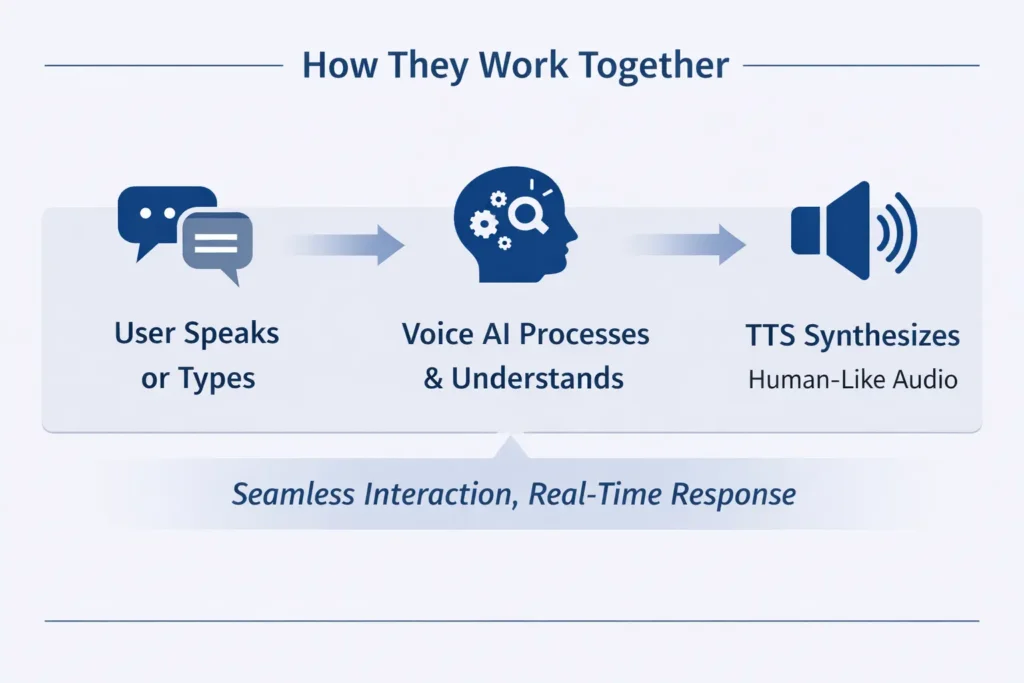
    Voice AI, Text to Speech or Type to Speech are not competing. They are complementary. Each addresses a different point in the communication chain.

    Voice AI handles understanding and generating language. Text to Speech handles the conversion of that language into natural audio and handles the real-time delivery of that audio during live interactions.

    A well-built voice application uses all. A user speaks or types a question. The Voice AI interprets it and generates a response. The TTS engine renders that response in a voice that sounds human. If the interaction is live, the Type to Speech layer ensures there is no uncomfortable gap between response and delivery.

    Getting this stack right is harder than it looks. Each layer needs to perform well independently and hand off cleanly to the next. A great TTS model plugged into a slow Voice AI pipeline can still produce a bad experience. The quality of the whole system depends on the quality of every part.

    This is where Shunya Labs puts its energy. We are not building one piece and calling it done. We are building the full stack with the same level of care at every layer. Our speech to text model handles accurate transcription across accents and noise conditions. Our TTS model is designed to match that same standard for naturalness and reliability. And the architecture underneath both is built for real-time performance.

    What strong voice AI looks like in practice

    It is easy to talk about voice quality in abstract terms. Here is what it actually looks like when a voice AI platform is doing its job properly.

    A call centre agent powered by voice AI picks up on the frustration in a customer’s voice and routes them to a human before they have to ask. A language learning app speaks back a student’s sentence with natural rhythm, not just correct phonemes. A content platform reads an article in a voice that matches the publication’s tone, not a generic neutral default.

    These outcomes require more than a decent model. They require latency that does not make interactions feel laggy. They require multilingual support that actually works across dialects, not just primary languages. They require the ability to fine-tune or customise voice output to fit a brand or context.

    Shunya Labs is built with these outcomes in mind. Not as feature checkboxes but as the standard we design around.

    Where voice technology is heading and what it means for you

    The near-term direction is clear. Models are getting faster. Personalisation is getting deeper.

    A few things worth watching over the next 12 to 18 months:

    • Emotion-aware synthesis. TTS systems that adjust tone and pacing based on the emotional weight of the content, not just the words.
    • Multilingual voice at production quality. Not translation-quality audio but broadcast-quality output across 50 or more languages from a single input.
    • Custom brand voices. Businesses create unique AI voices that are consistent across every customer touchpoint, from support calls to product narration.
    • Ambient voice interfaces. As more devices become voice-first, the interaction layer shifts from screen to speech for a growing share of daily tasks.
    • Fully integrated voice agents. AI systems that listen, reason, and respond in speech in real time, with the full context of a conversation maintained throughout.

    Each of these directions places more weight on the quality of the underlying voice models. The teams and platforms investing in that quality now will be the ones positioned to build on it when these use cases become standard.

    At Shunya Labs, that investment is already underway. With our capabilities of building custom full stack models, we are building toward a platform that handles the full voice layer for the products and teams that need it.

    Final thought

    Voice AI, Text to Speech and Type to Speech are names for specific tools. But they are all working toward the same thing. Communication that does not feel like a workaround.

    The gap between how humans talk to each other and how they talk to technology has been closing for years. In 2026, that gap is smaller than it has ever been. The tools are good enough now that the focus can shift from “does this work” to “does this feel right.”

    That is the question driving the work at Shunya Labs. And it is a question we think the industry is finally ready to answer well.

  • How to Choose a Speech AI Platform: The 2026 Evaluation Guide

    How to Choose a Speech AI Platform: The 2026 Evaluation Guide

    Most speech AI platform evaluations start in the wrong place.

    Teams look at marketing demos. They check whether a platform transcribes clean English well. They compare pricing tiers. Then they pick something and build on it. A few months later they discover it does not work on their actual audio, in their actual languages, under their actual compliance requirements.

    The problem is not that those teams made bad decisions. It is that they evaluated the wrong things.

    A speech AI platform that works brilliantly for a US-based SaaS company can fail completely for an Indian BFSI enterprise. Not because the platform is bad. Because the fit was wrong from the start.

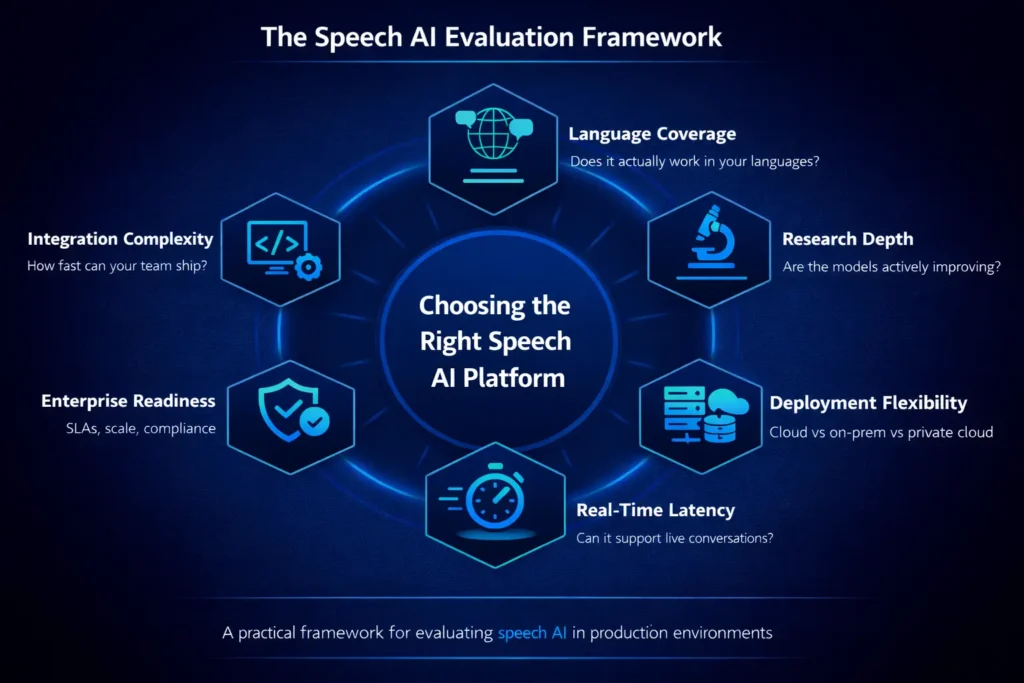
    This guide covers the six criteria that actually determine whether a speech AI platform works in production. Each one has a concrete test you can run before you commit to anything.

    Criterion 1: Language Coverage That Matches Your Users

    Language support is one of the most misrepresented metrics in speech AI. A platform that claims to support 50 languages is not the same as a platform that works well on 50 languages.

    The difference lies in how each language was trained. Global platforms add languages by extending their English-first models. That works for languages with large clean audio datasets: German, French, Mandarin, Spanish.

    It does not work when training data is thin, dialect variation is high, or real deployment audio looks nothing like studio recordings. That describes most Indian languages.

    For India, this gap is especially wide. The country has 22 official languages and hundreds of dialects. Code-switching between languages mid-sentence is standard for millions of speakers. A model trained primarily on English and extended to Hindi does not handle Bhojpuri, Marathi, or Telugu telephony speech reliably.

    So the question to ask is not how many languages a platform supports. It is: which languages were trained on real-world audio in real deployment conditions, and what is the word error rate on those languages measured independently?

    What to test

    Request WER data specifically for your target languages on telephony-quality audio, not studio recordings.

    Ask whether the model was trained on code-switched speech if your users mix languages mid-sentence.

    Run a blind test: record a few minutes of audio from your actual callers and test every shortlisted platform on the same file.

    Platforms trained on real-world audio for a language will perform significantly better than those that have extended English-first models.

    Shunya Labs models cover 200 languages including 55 Indic languages. Each Indic language is trained on real audio, code-switched speech, and regional dialect variation, not extended from an English base.

    Criterion 2: Research Depth Behind the Models

    Every speech AI platform has models. Not every platform has a research programme that is actively improving those models based on how they actually fail in production.

    The distinction matters more than it might seem. Speech AI is not a solved problem. Real-world audio is noisy, compressed, and full of domain-specific vocabulary that general models have never seen. A platform built on top of commodity models from three years ago will hit accuracy ceilings that a research-led platform can push past.

    Research-led platforms publish papers, benchmark against independent datasets, and improve their architectures continuously. You can see it in their model versioning history and their domain-specific vocabulary performance. Are they shipping new architectural approaches, or just repackaging existing ones?

    The practical test is simple: ask the vendor what changed between their last two model versions and what specific problem each change solved. A vendor with a real research programme can answer that precisely. A vendor reselling a commodity model usually cannot.

    What to look for

    Published research papers and benchmarks, especially on non-English and low-resource languages. Model architecture that reflects recent advances, not just fine-tuned versions of 2022-era models. A clear roadmap for specific language improvements, not generic promises of ‘continuous improvement’. Benchmark results on independent third-party datasets, not just internal evaluations.

    Zero STT by Shunya Labs is the most accurate speech recognition model on OpenASR benchmarks, achieving 3.10% World Error Rate (WER). The Indic language models were not adapted from English. They were built from the ground up on Indic audio data, which is why we achieve 3.1% WER on Indian speech where global platforms struggle.

    Criterion 3: Deployment Flexibility for Regulated Industries

    This is the criterion that eliminates the most platforms fastest, especially for Indian enterprise.

    Regulated industries like BFSI and healthcare cannot route audio to infrastructure they do not control. Under PDPB guidelines and RBI circulars, audio from Indian customer calls generally cannot leave India. Under HIPAA-equivalent frameworks in healthcare, patient audio must stay within defined boundaries.

    Most global speech AI platforms are cloud-only. You send audio to their US or EU servers, you get a transcript back. That architecture is simply not compliant for Indian BFSI or healthcare regardless of how good the transcription quality is.

    The platforms that work in regulated contexts offer one of three things. On-premise deployment, where the model runs on your own hardware. India-hosted infrastructure, where audio stays within Indian data centres. Or private cloud within a defined boundary you control.

    Ask your vendor three specific questions. Is the on-premise model the same version as the cloud model? Does it support streaming ASR? Can it run on CPU hardware without GPU infrastructure?

    What to ask your vendor

    Is on-premise deployment available, and is it the same model as the cloud version?
    Does it support streaming ASR in on-premise mode?
    Can it run on CPU-only hardware, or does it require GPU servers?
    What is the minimum hardware specification for a production deployment at your expected concurrent load?
    Is India-hosted cloud infrastructure available as an alternative to on-premise?

    Zero STT runs fully on-premise on CPU hardware, with no GPU requirement. This is the architecture that makes it viable for BFSI and healthcare teams in India who cannot route audio outside their own infrastructure.

    Criterion 4: Real-Time Latency That Supports Live Conversation

    If you are building anything interactive, latency is not a performance metric. It is a product requirement.

    Human conversation has a natural response window of 200 to 300 milliseconds. When a voice agent exceeds that, the interaction can start to feel broken. Users talk over the agent. Trust drops. Task completion falls.

    There are two latency numbers to care about. The first is streaming STT time-to-first-token: how quickly the ASR layer returns text after audio starts arriving. This should ideally be under 500 milliseconds for production real-time applications. The second is end-to-end turn latency: from the user stopping speaking to the agent starting its response. This should be under 800 milliseconds for natural conversation.

    Most vendor latency claims are measured in ideal conditions: clean audio, fast networks, small models. Real Indian deployments add variables that inflate those numbers. Telephony audio compression. India-to-US network round-trips can add 180 to 250 milliseconds per turn. On-device inference removes the network round-trip entirely, which is why it consistently beats cloud-routed alternatives for Indian field operations and contact centre use cases.

    What to measure

    Streaming STT time-to-first-token: should be under 500ms. Test on your actual audio format, not a clean demo file.
    End-to-end turn latency: should be under 800ms for live conversation. Measure from end of speech to start of agent audio.
    Measure at your expected peak concurrent load, not on a single test call.
    For India deployments: measure latency with India-origin audio.

    Criterion 5: Enterprise Readiness Beyond the Demo

    There is a significant gap between a platform that works in a proof-of-concept and one that works at production scale in an enterprise environment.

    Enterprise readiness covers several things that often do not show up in a demo. Concurrent connection limits: how many simultaneous calls can the platform handle before quality degrades? SLA terms: what uptime is guaranteed, and what compensation exists if it is not met? Support response times: when something breaks at 2am before a launch, who answers?

    For Indian enterprise specifically, there are additional dimensions. Does the vendor have experience with Indian audio at scale? Can they provide Indian reference customers in your vertical? Do they understand the specific compliance requirements of RBI, IRDAI, or the healthcare data frameworks you operate under?

    A vendor who has only shipped to US enterprises will know the HIPAA and SOC 2 landscape well. They will not necessarily know how Indian BFSI compliance maps to deployment architecture, or what audit documentation Indian regulators expect. That knowledge gap creates risk.

    Enterprise checklist

    Concurrent call capacity at your expected peak load, with documented degradation behaviour above that limit.
    SLA with uptime guarantees and clear remediation terms, not just ‘best effort’.
    Support tier that includes named contacts and response time commitments for production issues.
    Reference customers in your vertical and geography, not just logo references.
    Compliance documentation relevant to your regulatory framework, not just generic SOC 2 or GDPR certification.

    Criterion 6: Integration Complexity and Time-to-Production

    A platform that takes three months to integrate is not a good platform for teams with a six-month roadmap.

    The integration complexity question covers two things. First, the API design: is it REST or WebSocket? For streaming ASR, WebSocket is standard and integrates in hours. Complex authentication schemes like AWS Signature V4 or proprietary gRPC can add weeks to integration timelines, especially for teams without deep cloud experience.

    Second, SDK quality. A well-maintained SDK with working examples cuts integration time from weeks to days. Ask to see it before you commit. Run the quickstart. If it takes over an hour to get a working transcription from a test file, that can tell you something about the full integration experience.

    For voice agent applications, also ask about the full pipeline. Does the platform provide just ASR, or does it offer a complete STT-plus-LLM-plus-TTS pipeline? If you need to wire three separate vendors together, you own the integration surface and every latency problem at each handoff. Some teams prefer that control. For others, a unified pipeline is worth the reduced flexibility.

    Integration signals to watch

    WebSocket API for streaming ASR: integrates in hours. Complex auth schemes: add days to weeks.
    Working SDK quickstart that runs in under an hour.
    Active documentation with examples in your language stack.
    Clear answer on whether pipeline components (STT, LLM, TTS) can be used independently or only as a bundle.

    Criterion 6: Integration Complexity and Time-to-Production

    How Leading Platforms Compare on These Six Criteria

    This table uses publicly available information and is accurate as of March 2026. Enterprise features and pricing change frequently. Verify with vendors before making a final decision.

    PlatformIndic Language SupportResearch-Led ModelsOn-Premise / CPUStreaming LatencyIndia Enterprise FocusIntegration Ease
    Shunya Labs200 languages, 55 Indic (deep)YesYes, CPU-onlyExcellent, Sub-50ms on-deviceYesExcellent WebSocket
    DeepgramLimited (English-first)Yes, active researchYes (GPU required)ExcellentNoExcellent
    Azure SpeechHindi, some IndicLarge scale, broadYes (GPU required)GoodPartialGood
    Google STT22 languages (limited depth)Broad, English-firstVia Anthos (complex)GoodNoGood
    AssemblyAIVery limitedYes, active researchYes (self-hosted)GoodNoGood
    SpeechmaticsLimitedYes, strong researchYesExcellentNoGood

    Frequently Asked Questions

    What is the most accurate speech AI platform for Indian languages?

    Accuracy on Indian languages depends entirely on which languages you need and what audio conditions you are working with. For standard Hindi in clean audio, most major platforms perform acceptably. For regional Indian languages like Telugu, Marathi, Bhojpuri, Odia, or Assamese over telephony audio, platforms specifically trained on Indic data perform significantly better. The only reliable way to measure this is to test on your actual audio, not rely on vendor-provided benchmarks. Shunya Labs is one of the platforms that has high accuracy in Indic languages.

    Can a speech AI platform run without sending audio to the cloud?

    Yes, several platforms offer on-premise deployment. The important check is whether the on-premise version uses the same model as the cloud version and whether it supports streaming ASR. Some vendors offer on-premise as a reduced-feature option, which is worth clarifying before you build your architecture around it. CPU-first on-premise deployment, which runs without GPU hardware, is the most practical option for most Indian enterprise teams.

    How many languages does a speech AI platform need to support?

    The number matters less than which languages and how well. A platform that supports 10 languages with production-grade accuracy on real-world audio is more useful than one that supports 100 languages at inconsistent quality. For India, a practical enterprise deployment often needs 5 to 10 specific Indic languages at high accuracy, plus Indian-accented English. Start with your actual user distribution and work backwards to the language requirement.

    What should I prioritise when choosing between a specialised platform and a big cloud provider?

    Big cloud providers win on ecosystem integration, geographic coverage, and compliance certifications for Western regulatory frameworks. Specialised platforms win on accuracy for specific domains or languages, deployment flexibility, and typically on latency. For Indian enterprise teams who need Indic language accuracy, on-premise deployment, and a vendor who understands Indian compliance requirements, a purpose-built platform is almost always the better choice. The integration and ecosystem tradeoffs are real, but they are usually solvable. The language accuracy gap is much harder to close after deployment.

    The Evaluation Framework in Summary

    Run through these six questions before you shortlist any speech AI platform:

    • Does it support your specific languages at production-grade accuracy on real-world audio, not just in demos?
    • Is there genuine research behind the models, or is it a fine-tuned commodity model with a marketing layer?
    • Can it run on-premise on CPU hardware, with the same model and streaming support as the cloud version?
    • What is the measured end-to-end latency on your actual audio format at your expected call volume?
    • Does the vendor have enterprise-grade SLAs, support, and reference customers in your vertical and geography?
    • How long does integration actually take? Run the quickstart before you commit.

    The platforms that clear all six bars are a short list. That is the point. Better to know that before you build than six months into a production deployment.

    Shunya Labs

    200 languages including 55 Indic languages, trained on real audio and code-switched speech. Not extended from English.
    Most accurate speech recognition model with 3.1% WER.
    On-premise, CPU-first deployment. Same model as cloud. Full streaming ASR support. PDPB and RBI-compliant architecture.
    Enterprise deployments in BFSI and healthcare.
    Start free at shunyalabs.ai or talk to the team at shunyalabs.ai/contact

  • Speech AI in 2026: What It Is and How Real-Time Voice Is Changing Every Industry

    Speech AI in 2026: What It Is and How Real-Time Voice Is Changing Every Industry

    TL;DR , Key Takeaways:

    • Speech AI is not one technology. It is a stack: STT converts speech to text, LLMs reason over it, TTS turns a response back into speech. Each layer has improved dramatically since 2023.
    • Real-time voice went from demo-quality to production-ready in 2025 when latency dropped below 500ms consistently. That single threshold change opened the market.
    • India’s voice AI opportunity is unlike anywhere else: 22 official languages, 1.2 billion mobile users, and industries like BFSI and healthcare with massive call volumes and severe automation gaps.
    • The five industries being transformed fastest are BFSI, healthcare, contact centres, field operations, and media. Each has its own dynamics and readiness level.
    • Platform matters more than model. Teams that pick the right foundational speech infrastructure avoid rebuilding from scratch as requirements evolve.

    Speech AI gets thrown around as though it means one thing. It does not. When a call centre deploys a voice bot, that is speech AI. When a doctor dictates clinical notes and they appear as text without typing, that is also speech AI. When a video gets dubbed into six regional languages overnight, same category.

    These applications feel very different because they solve different problems. But they all use the same three technologies: something that listens, something that reasons, and something that speaks. Understanding each layer helps you choose the right tools. It also helps you have better conversations with vendors who will often blur the lines.

    This post explains what speech AI is. It covers how each layer works, where it breaks down, and what real-world use looks like today.

    What Speech AI Actually Is in 2026

    The term is used to mean at least four different things. Knowing the difference matters when you are picking infrastructure.

    The first and most basic is speech recognition, or ASR. It converts spoken audio into text. This is what people mean by STT (speech to text). It is the input layer of any voice application. Everything downstream depends on how accurate and fast this step is.

    The second is speech synthesis, or TTS. It converts text back into spoken audio. In 2026, neural TTS often sounds just like a human in controlled conditions. The AI voice generator market was worth $4.16 billion in 2025. It is projected to reach $20.71 billion by 2031, growing at 30.7% CAGR (MarketsandMarkets). The TTS segment is led by APIs and developer tools, growing fastest at 34.7% CAGR.

    The third is voice AI agents. These systems combine STT, an LLM, and TTS into a real-time conversation loop. They power the voice bots handling customer calls, taking appointments, and processing loan applications. This segment is the fastest-growing part of the stack. It was estimated at $2.4 billion in 2024 and is projected to reach $47.5 billion by 2034.

    The fourth is speech analytics. It processes recorded or live calls to pull out useful data. This includes sentiment, compliance flags, key phrases, emotion detection, and agent quality scores. It serves a different buyer than the real-time stack. But it runs on the same underlying speech recognition models.

    Each layer has different performance needs and different vendors. You would not choose a TTS provider based on STT benchmarks. You would not evaluate an analytics platform the same way you evaluate a live agent system. Knowing which layer you need is the first decision you have to make.

    The Three Layers That Make Up Speech AI

    Every speech AI system is built from some mix of three parts. You can use each one on its own. But the most powerful apps combine all three.

    Layer 1: Speech Recognition (ASR / STT)

    This is the listening layer. Automatic Speech Recognition (ASR) converts spoken audio into text. It is the input to everything else. If this step is inaccurate, nothing else works well.

    Modern ASR models use deep learning. Most are built on Conformer or Transformer architectures, trained on thousands of hours of audio. They learn patterns: which sounds map to which words, in which contexts. When a model is trained on one language and used on another, those patterns break. A model with 5% error on US English can easily hit 25% or higher on regional Indian languages over phone audio.

    In 2026, the key technical split is between batch and streaming ASR. Batch ASR waits for a full recording before transcribing. Streaming ASR processes audio as it arrives and returns text in real time. For analytics, batch works fine. For any live voice interaction, streaming is not optional. The architecture sets the latency floor for the whole app.

    Layer 2: Language Models (LLM)

    Once you have text, something needs to understand it and decide what to do. In most modern speech AI systems, that is a large language model (LLM). The LLM reads the transcript, reasons over it, and either responds or takes an action.

    The LLM is where most of the intelligence lives. It decides whether the agent handles tricky questions, topic switches, or domain-specific queries. It also decides when to hand off to a human. The ASR layer gives the LLM words. The LLM decides what those words mean and what to do about them.

    For real-time voice, LLM response time is usually the biggest cause of delay. A well-configured STT layer might add 100ms. A standard LLM call on a large model adds 400ms to over 1 second. This is why model size matters. A well-prompted 7B parameter model handles most voice agent tasks faster and cheaper than a 70B model. For constrained tasks like booking or collections, there is no meaningful quality difference.

    Layer 3: Speech Synthesis (TTS)

    The output layer converts the LLM’s text response back into spoken audio. TTS has improved faster than any other part of this stack over the last two years. Neural TTS voices today are often hard to tell from human recordings in controlled conditions.

    Most people miss one thing about TTS in real deployments: voice quality affects how smart the agent seems. A slow, robotic response feels less trustworthy, even if the words are the same. For customer-facing apps in India, callers are sensitive to whether the agent sounds like it understands them. TTS quality directly affects task completion rates.

    Speech AI in Practice: The Five Industries Being Transformed Fastest

    1. BFSI The Highest Volume, the Highest Stakes

    Indian banks and insurers handle tens of millions of customer calls every month. Most of those calls cover a small set of needs: balance queries, EMI schedules, policy renewals, claim status, and loan eligibility.

    In FY23-24, 95 Indian banks received over 10 million complaints. The RBI is pushing banks to use AI to sort, tag, and resolve them faster. 57% of BFSI institutions already use voice analytics to track interaction patterns, according to Mihup.ai (October 2025).

    Key use cases span five workflows: customer onboarding, loan processing and collections, fraud detection via voice biometrics, policy renewals, and multilingual support. HDFC and ICICI are publicly deploying voice bots for onboarding and queries. NBFCs are using AI calls for lead qualification and collections. One analysis found lead qualification costs falling from Rs 800 to Rs 120 per lead with voice AI. Organisations report 20–30% cuts in operating costs overall.

    Compliance adds a layer specific to India. PDPB rules mean audio from Indian customer calls cannot freely leave the country. For BFSI, voice AI that runs on-premise or on India-hosted endpoints is not a nice-to-have. It is the only viable architecture.

    2. Healthcare: The Fastest Growing Adoption Rate

    Healthcare conversational AI is growing at 37.79% CAGR, the fastest of any sector. Voice AI could save the US healthcare economy $150 billion annually by 2026, according to Fortune Business Insights. But the India story is different. Here, the priority is not saving physician time on paperwork. It is reaching patients who had no access before

    A Hindi-speaking patient in a tier-3 city needs a system that speaks their language. It must understand medical terms in that language and handle regional accents. Global ASR models often fail at this. Models trained on clean English clinical speech do not transfer to code-switched, accented Hindi medical calls.

    The problem in Indian healthcare is not lack of willingness to adopt. It is the quality of speech models on Indic languages in clinical settings.

    3. Contact Centres and BPO: The Structural Disruption

    India’s BPO industry is facing its sharpest challenge in two decades. Traditional call centres run 30-50% attrition, night-shift fatigue, and rising costs. One voice AI agent can handle thousands of calls a day with none of those constraints. The ROI numbers are stark: e-commerce support costs drop 40-50%, productivity gains reach 320%, BFSI query resolution improves up to 80%, and customer satisfaction scores rise 12+ points.

    The pattern emerging is not full replacement. It is tiered automation. Tier 1 queries go to voice AI. Tier 2 queries use AI with human escalation. Tier 3 goes to human agents with AI assist. Smaller Tier-2 BPOs are already winning hybrid deals. The phrase in enterprise RFPs today is simply: Are you AI-ready?

    India’s call centre industry is projected to grow at 8-10% CAGR over the next five years. Voice AI is not stopping that growth. It is reshaping what that growth looks like.

    4. Field Operations: The Overlooked Vertical

    The least talked-about but most India-specific use of voice AI is in field operations. This covers insurance agents, FMCG field sales, microfinance collection agents, agricultural workers, and logistics staff. These workers are mobile, often in low-connectivity areas, frequently non-English speaking, and work entirely through conversation.

    As Mathangi Sri Ramachandran of YuVerse noted in Inc42’s January 2026 analysis, voice is going to occupy a lot of the commercial transaction space in India. Voice can be used to troubleshoot machines on-site. Field agents use it to log activity, process collections, and update CRMs without typing. For these users, voice is not a convenience. It is the only interface that fits how they work.

    On-device speech models The infrastructure here has distinct needs. It requires offline capability or very low connectivity tolerance. It needs sub-100ms STT on CPU hardware without cloud round-trips. It also needs strong support for regional languages at high noise levels. This is exactly where on-device speech models outperform cloud-based options on every metric that matters.

    5. Media and Entertainment: The Scale Play

    The media vertical is growing in a different way. The driver is not automating human conversations. It is creating new content at a scale that was not possible before. Key use cases include multilingual dubbing, regional voiceovers for OTT content, AI audio narration for short video, and dynamic ad personalisation by language and dialect.

    The media and entertainment segment holds the largest revenue share in AI voice generators. For India, the value is localisation at scale. Dubbing a series into 10 regional languages manually takes months and costs crores. AI-assisted dubbing with voice cloning can cut both to days and lakhs.

    IndustryAdoption StagePrimary Use CasesKey India Factor
    BFSIScaling fastCollections, onboarding, fraud detection, multilingual supportPDPB compliance requires on-premise or India-hosted infra
    HealthcareFastest CAGR (37.79%)Appointments, patient follow-up, clinical documentationRegional language accuracy in clinical contexts is unsolved globally
    Contact CentresStructural disruptionL1 automation, quality monitoring, agent assist30-50% attrition makes AI augmentation essential, not optional
    Field OperationsEarly but strategicActivity logging, collections, CRM update via voiceOffline capability and low connectivity tolerance required
    Media / OTTVolume playDubbing, voiceover, regional audio content at scale22 official languages creates localisation demand no other market matches

    How to Think About Choosing a Speech AI Platform

    The Google keywords data shows that searches for ‘voice AI platform’ are growing 9,900% YoY and ‘conversational AI platform’ are growing 900% YoY. These searches may come from buyers who have decided they need something and are now comparing options. How you frame the decision matters.

    Real-time voice agents need sub-500ms end-to-end latency. Analytics platforms instead require vocabulary accuracy and cross-language prosody support.

    Start with deployment requirements, not features

    The most common mistake when evaluating speech AI is starting with model accuracy benchmarks on English audio. For most Indian enterprise deployments, the first filter should be deployment mode. Can this run on-premise? Can audio stay within Indian infrastructure? Is there a CPU-first option with no GPU needed? These questions alone rule out most global cloud providers before you even compare features.

    Measure what matters for your use case

    Real-time voice agents need sub-500ms end-to-end latency and sub-100ms STT time-to-first-token. Analytics platforms need high keyword recall and domain vocabulary accuracy. Dubbing workflows need natural voice quality and cross-language prosody. These are different metrics. Picking a provider based on one universal benchmark can miss this entirely.

    Test on your actual audio

    Published WER benchmarks use standard clean audio. Production Indian audio is not a clean corpus. The only number that matters is the error rate on your actual audio: your callers, your languages, your conditions, your domain vocabulary. Any speech AI provider worth evaluating will let you run that test before you commit.

    Think about the full stack before picking a layer

    If you are building a voice agent, you need STT, an LLM, and TTS. If you pick these from three separate providers, you own the integration, the latency budget, and the failure points. Some teams prefer that control. Others prefer a platform that handles the full pipeline. The right answer depends on your engineering capacity and how much of the stack is core to your product.

    How Shunya Labs Fits Into This

    Shunya Labs is built specifically for the deployment constraints that matter most in Indian enterprise: CPU-first architecture that runs on-premise without GPU hardware, sub-100ms on-device latency, and models trained on Indic audio with production-grade accuracy. 200-plus language support including all major Indic languages and dialects. n.
    For BFSI, healthcare, and field operations teams who cannot route audio to cloud infrastructure or need latency that cloud round-trips make impossible, on-device speech AI is not a tradeoff. It is the right architecture.

    References

  • Why Sub-100ms Voice AI Latency Is the New Table Stakes (And How to Achieve It)

    Why Sub-100ms Voice AI Latency Is the New Table Stakes (And How to Achieve It)

    TL;DR , Key Takeaways:

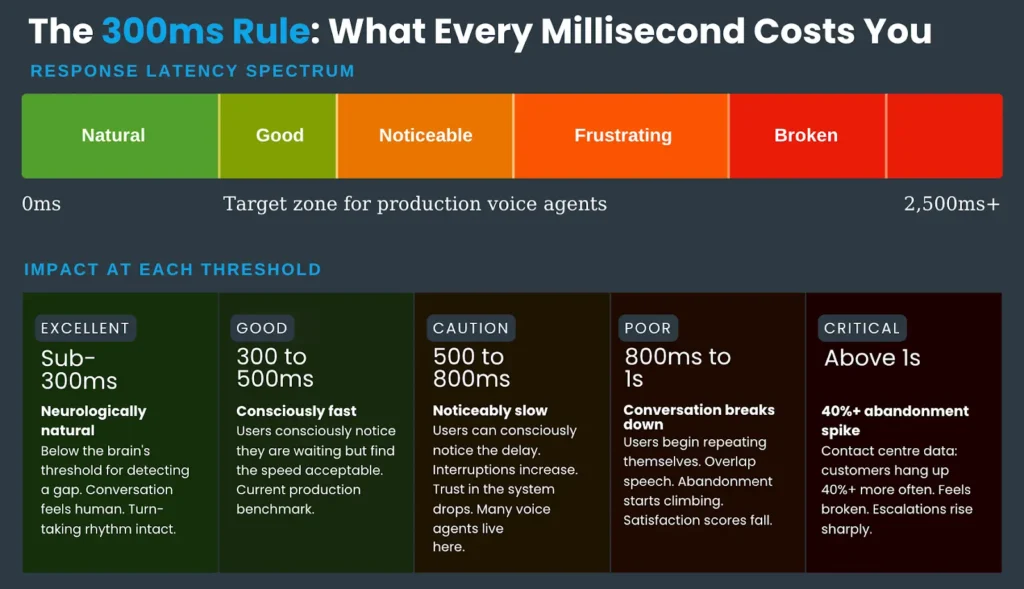
    • Human conversation has a 200 to 300ms natural response window. Above 500ms, users consciously notice the lag. Above 1 second, abandonment rates climb sharply.
    • Most voice agents in production today run at 800ms to 2 seconds, not because the models are slow, but because pipeline stages compound silently.
    • The four latency culprits are audio buffering, STT processing, LLM inference, and TTS synthesis. Each stage can be tuned independently.
    • Sub-100ms is achievable at the STT layer right now. Getting the total pipeline below 500ms is an architecture problem, not a model problem.
    • On-device CPU-first STT eliminates network round-trips entirely and satisfies data residency requirements for Indian enterprise deployments.
    • WebSocket over REST, streaming everywhere, right-sized LLMs, and regional or on-premise inference: these four choices close most of the gap.

    There is a moment in every voice AI demo where something clicks. The agent responds quickly, the rhythm feels right, and the conversation moves forward the way a real conversation does. Then the same team ships to production, and the first thing users say is: “Why does it pause so long?”

    That pause is not a model problem. Benchmarks published in late 2025 from 30-plus independent platform tests show that most voice agents in production still clock in at 800ms to two full seconds end-to-end.

    The reason is pipeline compounding. Every stage in the voice agent stack adds time, and those stages run sequentially. Each handoff adds overhead. Endpointing waits for silence. Audio buffers in chunks. The LLM waits for a complete transcript. TTS waits for a complete LLM response. By the time sound reaches the user’s ear, a dozen small decisions have each added 50 to 200 milliseconds, and the total has long since crossed the threshold where conversations feel natural.

    This post pulls that apart layer by layer. What are the actual numbers at each stage? Where do teams waste the most time? What does a well-architected low-latency pipeline look like in 2026? And what does it mean specifically for teams building in India, where geography adds an unavoidable physics tax on top of

    Natural human response window

    The gap the brain expects between turns

    Abandonment spike above 1 second

    Contact centre data, 2025–2026 benchmarks

    Typical production agent today

    Despite sub-200ms component speeds

    The 300ms Rule and Why It Is Not Just a User Experience Concern

    Research consistently puts the natural human conversational gap at 100 to 400 milliseconds. This is not a UX preference, it is a neurological baseline. Beyond 300ms, users may not consciously register a delay. Beyond 500ms, they can consciously notice it. Beyond one second, the conversation starts to feel broken, users may speak again assuming the agent did not hear them, interruptions multiply, and abandonment rates spike. Abandonment rates climb more than 40% when latency exceeds one second.

    Latency is a paralinguistic signal. When a voice agent pauses, users read that pause as meaning something uncertain, failure, machine-ness. The rhythm of a conversation can shape how its content is received.

    There is also an operational cost here that is separate from user experience. Longer interactions cost more to run. More pauses can mean more false turn detections, more correction cycles, more agent time per call. A team handling 50,000 calls a day saw clean average latency metrics, but churn and complaints stayed high because their P99 latency was spiking, affecting a small but vocal slice of users consistently.

    This is the case for tracking P95 and P99 metrics, not just averages. A 400ms average with 2-second P99 spikes means users are abandoning calls even though the dashboard looks fine.

    Where the Time Actually Goes: The Pipeline Breakdown

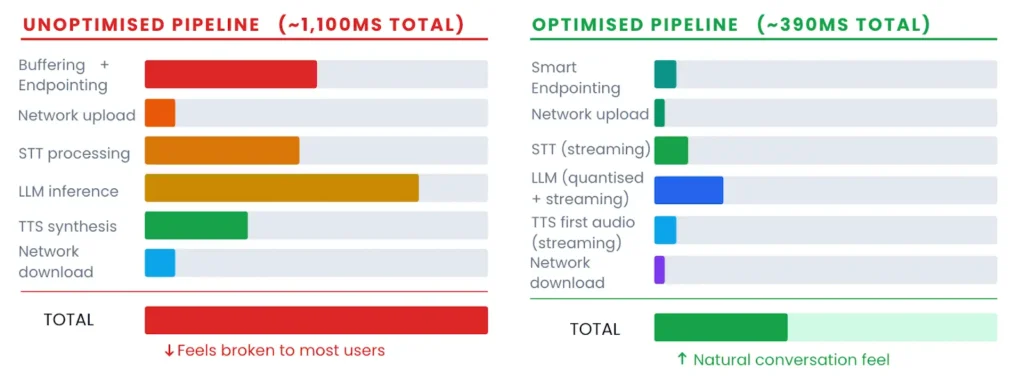
    The standard cascaded voice agent pipeline has six sequential stages, each contributing to the total latency. This is what Introl’s voice AI infrastructure guide published in January 2026 summarises as the core equation: STT + LLM + TTS + network + processing equals roughly 1,000ms for a typical deployment, even when individual components are performing well.

    Pipeline StageTypical RangeOptimised TargetMain Lever
    Audio buffering + endpointing250 to 600ms20 to 80msStreaming chunks + smart endpointing model
    Network upload (audio)20 to 100ms20 to 40msEdge proximity, WebSocket
    STT processing (cloud)100 to 500msSub-100ms (streaming)Streaming Conformer model, regional endpoint
    STT processing (on-device)250 to 520ms typicalSub-50msCPU-first model, no network hop
    LLM inference350ms to 1,000ms+150 to 300msModel size, 4-bit quantisation, streaming
    TTS synthesis (first audio)100 to 400ms40 to 95msStreaming TTS, fire on first sentence
    Network download (audio)20 to 100ms20 to 40msEdge proximity, WebSocket
    Total (unoptimised)800ms to 2,000ms300 to 500msArchitecture across all layers

    A few things stand out. First, audio buffering and endpointing are responsible for far more latency than most teams expect. Traditional silence-based endpointing defaults to a 500ms wait window before deciding a user has finished speaking. That 500ms alone exceeds the entire optimised target for some pipeline stages. Second, the LLM is almost always the single largest contributor once you have sorted the front end. Third, the gap between typical and optimised is not a technology gap. These optimised numbers are achievable today with components that are already in production.

    Stage One: Audio Buffering and Endpointing

    Most teams skip past this because it feels like plumbing rather than AI. That is a mistake. Endpointing is where many pipelines lose 300 to 600ms before any model has seen a single byte of audio.

    Traditional end-of-turn detection works on silence. The system waits for the user to stop speaking, then waits a further 500ms silence window to confirm the turn is over, then passes the full buffer to STT. Most silence-based endpointing defaults sit around 500ms, and reducing that threshold is risky because natural pauses inside a sentence can look like end-of-turn events. The result is a system that either cuts people off mid-sentence or adds 500ms of avoidable latency on every turn.

    Smart endpointing replaces silence detection with a trained model that reads richer signals: prosody, semantic completion, vocal pattern. Models must be built specifically for this task: detecting when a speaker stops talking as fast as possible. Because it should understand context rather than just silence, it can use tighter timing thresholds without the false-positive problem. Faster endpointing can directly reduce the time before the STT model even begins.

    What to do at this stage

    • Use 20ms streaming audio chunks rather than 250ms buffers. Smaller chunks mean transcription begins sooner.
    • Replace silence-based endpointing with a dedicated smart endpointing model. The latency saving is 200 to 400ms per turn in most pipelines.
    • Use WebSocket connections throughout. REST APIs add 50 to 100ms of connection overhead per request. Over a 10-turn conversation that is 500ms to 1 second of cumulative waste.

    Stage Two: STT Processing and the Streaming vs Batch Divide

    This is where most latency discussions start, but it is actually step two of the problem. STT architecture is the difference between a pipeline that can hit sub-100ms and one that cannot.

    Batch STT waits for a complete audio buffer before transcription begins. Streaming STT transcribes continuously as audio arrives, returning partial outputs in real time using Connectionist Temporal Classification (CTC)-style alignment-free decoding approaches that produce frame-synchronous output without waiting for the full utterance. The difference in time-to-first-token is large: batch systems typically take 300 to 500ms, streaming systems deliver first tokens in under 100ms in production.

    Conformer-based architectures have become the standard for low-latency streaming ASR. They combine convolutional layers for local acoustic patterns efficiently with self-attention for longer-range dependencies. A 2025 arXiv paper on telecom voice pipelines using a Conformer-CTC architecture achieved real-time factors below 0.2 on GPU, meaning the model processes audio faster than it arrives.

    What to do at this stage

    • Use a streaming model with a WebSocket interface, not a REST batch endpoint. The architecture choice alone shifts latency from 300 to 500ms to sub-100ms.
    • For Indian enterprise deployments or any use case where audio cannot leave a defined network boundary, CPU-first on-device STT eliminates the network round-trip and often produces lower total latency than cloud despite processing entirely on commodity hardware.
    • Match model to use case. If your deployment is Indic language, code-switched, or telephony audio, a model trained on those conditions will outperform a general-purpose model on both accuracy and effective latency, because fewer transcription errors means fewer correction cycles.

    Stage Three: LLM Inference- The Biggest Budget Item

    Once you have solved endpointing and STT, the LLM is almost always the place where latency budgets collapse. Standard LLM inference on a large model takes 350ms to well over one second depending on context length, model size, and available compute. For a pipeline already at 150ms STT, a 700ms LLM call produces a total latency of 850ms before TTS has even started.

    AssemblyAI’s engineering team made a point worth quoting directly: reducing TTS latency from 150ms to 100ms sounds meaningful, but if your LLM takes 2,000ms, you have improved total latency by 2.5%. The optimisation effort should go where the time actually is.

    There are four well-established approaches to this, all of them practical in 2026:

    1. Stream LLM output to TTS from the first token. Do not wait for a complete response before starting synthesis. Fire the TTS call as soon as the first sentence is available, then continue streaming. This parallelises two expensive stages and reduces perceived latency dramatically because the user begins hearing the response while the model is still generating.
    2. Apply 4-bit quantisation. A 2025 arXiv paper on telecom voice pipelines found that 4-bit quantisation achieves up to 40% latency reduction while preserving over 95% of original model performance. For most voice agent tasks, the accuracy tradeoff is imperceptible.
    3. Right-size the model. A 7B or 13B parameter model processes a turn significantly faster than a 70B model, and for most constrained voice agent tasks, intent classification, FAQ response, appointment booking, a well-prompted small model performs a large general model on both speed and cost.
    4. Pre-load retrieval context. If your agent uses RAG, load the domain documents before the call begins rather than retrieving at inference time. For constrained domains, cache common response patterns entirely to bypass inference for known queries.

    What to do at this stage

    • Implement streaming token-to-TTS from the first sentence. This single change typically reduces perceived latency by 200 to 400ms with no model changes.
    • Profile your LLM’s P95 and P99 latency, not just averages. Spikes at P99 are what users complain about, and they often reveal queue depths, cold starts, or context length issues that averages mask.
    • Test whether a smaller quantised model meets your quality bar before defaulting to the largest available model. For most voice agent use cases, it does.

    Stage Four: TTS Synthesis and the Last Hundred Milliseconds

    TTS has improved faster than any other component in the voice AI stack over the last 18 months. Most tools are genuinely fast, and the architecture for squeezing more out of TTS is straightforward: stream.

    Start synthesis the moment the first sentence of LLM output arrives. Play that audio to the user while the model generates the second sentence. Continue streaming. The user experiences near-zero TTS latency because audio starts before synthesis is complete. Hamming AI’s latency guide notes that streaming TTS can reduce perceived latency to under 100ms for the user even when full synthesis takes 300ms, because what matters is time-to-first-byte, not time-to-complete-audio.

    One nuance the Twilio team identified is worth keeping: a faster system can feel subjectively slower if the voice is less expressive. Prosody and naturalness affect perceived latency even when the actual milliseconds are the same. For customer-facing applications, test voice quality alongside speed metrics. A 10ms slower TTS that sounds noticeably more human often wins on user satisfaction even though it loses on the dashboard.

    The Network Layer: The Variable Nobody Optimises

    Model and pipeline choices get most of the engineering attention. Network architecture gets almost none of it, and for teams building in India, this is where the most avoidable latency lives.

    Geography can create latency that no model optimisation can overcome. A round trip from Mumbai to a US-East endpoint adds 180 to 250ms of network latency purely from physics, before any processing. On a multi-turn conversation, that compounds to multiple seconds of cumulative overhead. The simplest fix is also the most impactful: use a regional endpoint.

    Architecture ChoiceLatency ImpactWhen to Use
    REST API (per request)+50 to 100ms per turnBatch workflows only, never for real-time voice
    WebSocket (persistent)Near-zero connection overheadAll real-time voice applications
    Cloud, US endpoint (from India)+180 to 250ms per turnWhen data can leave India and regional is unavailable
    Cloud, India regional endpoint+20 to 50msDefault for India deployments
    On-device / on-premiseSub-100ms (no network)Regulated industries, air-gap, DPDPB compliance

    For Indian enterprise deployments, this is a critical calculation. The DPDPB and sector-specific regulations in BFSI and healthcare create data residency requirements that make US-endpoint cloud routing genuinely problematic, not just slow. On-premise or edge deployment of the STT layer solves both problems simultaneously; it eliminates the network latency penalty and satisfies data residency without any quality compromise, because modern CPU-first models run at production-grade accuracy without cloud infrastructure.

    Putting It Together: A Realistic Latency Budget

    Good latency engineering starts from a budget. Here is a realistic target breakdown for a sub-500ms voice agent pipeline using current technology:

    ComponentTarget BudgetHow to Hit It
    Audio buffering20 to 40ms20ms streaming chunks, WebSocket from the start
    Smart endpointing50 to 80msDedicated endpointing model, not silence detection
    STT (cloud, regional)80 to 120msStreaming Conformer CTC, India regional endpoint
    STT (on-device)Sub-50msCPU-first model, zero network overhead
    LLM inference150 to 250ms7B to 13B quantised model, stream from first token
    TTS first audio40 to 95msStreaming TTS, fire on first LLM sentence
    Network round-trip20 to 40msRegional endpoint or on-device, WebSocket
    Total (cloud path)360 to 525msWell-architected cascaded pipeline
    Total (on-device STT)280 to 415msOn-device STT + cloud LLM + streaming TTS

    A few things stand out in this budget. The LLM is still the single largest item, which is why right-sizing it matters more than shaving milliseconds off TTS. On-device STT produces lower total latency than cloud STT in most India deployments, because eliminating zooms of network overhead outweighs any processing difference. The gap between the optimised total and the typical production total, 300 to 500ms versus 800 to 2,000ms, is not explained by model capability. It is explained by architecture decisions at every stage.

    The teams winning on latency are not using faster models. They are using better architecture; streaming at every layer, right-sized LLMs, regional or on-device inference, and WebSocket connections throughout.

    Latency Is an Architecture Problem

    The teams shipping sub-500ms voice agents in 2026 are not using secret models or experimental infrastructure. They are making better architecture decisions at every layer: streaming audio from the start, using smart endpointing instead of silence windows, right-sizing their LLMs, streaming TTS from the first token, and placing inference as close to users as data residency requirements allow.

    Sub-100ms STT is achievable today. The gap between that and a total pipeline below 500ms is a series of well-understood engineering choices, not unsolved problems. The reason most production agents are still at 800ms to two seconds is that teams optimise components in isolation rather than profiling the pipeline as a whole and finding the actual bottleneck.

    For teams building in India, for BFSI, healthcare, contact centres, regional language applications, there is an additional dimension. Geography is a physics problem, not a software problem. On-device CPU-first STT resolves it cleanly: no network round-trip, full data residency compliance, and latency performance that often beats cloud from a standing start. The architecture that satisfies compliance requirements turns out to also produce the fastest pipelines.

    Build the pipeline right from the start. Latency is much easier to architect in than to retrofit.

    Try Zero STT by Shunya Labs

    Zero STT is built for low-latency production deployment: CPU-first architecture, streaming Conformer-CTC models, sub-100ms on-device and full on-premise or edge deployment for Indian data residency requirements.

    Covers 200+ languages including all major Indic languages. Production-grade accuracy on telephony audio, code-switched speech, and noisy environments.

    View latency benchmarks at shunyalabs.ai/benchmarks or start with free API credits at shunyalabs.ai/zero-stt.

    References

  • Why Indic Language Voice AI Is the Biggest Untapped Opportunity in Tech

    Why Indic Language Voice AI Is the Biggest Untapped Opportunity in Tech

    TL;DR , Key Takeaways:

    • Over 900 million Indians are online in 2025, and 98% consume content in Indic languages, yet nearly every major voice AI platform was built for English-first users.
    • Standard ASR systems produce Word Error Rates above 30% on real-world Indic audio; code-switching (e.g. Hinglish) makes accuracy worse still.
    • India’s conversational AI market is growing at 26.3% CAGR toward $1.85B by 2030, with voice the fastest-growing interface.
    • The companies that solve multilingual Indic voice today will likely own the infrastructure layer for the next billion users coming online.
    • This post explains why the problem is technically hard, why it has been commercially ignored, and what the architecture of a real solution looks like.

    Picture this: A bank customer in Lucknow calls a contact centre voice bot and says “Mera account mein paisa credit nahi hua, please check karo.” The bot, built on a globally recognised ASR platform, returns a 40% word error rate. The word “credit” is transcribed as “cradle.” The word “paisa” is dropped entirely. The bot asks the customer to repeat themselves three times before escalating to a human agent.

    This is not a hypothetical. It is what happens every day across millions of enterprise voice deployments in India. And it represents a market failure hiding in plain sight.

    More than 900 million people are online in India today, the second-largest internet user base on earth. Among them, 98% consume content in Indic languages, with Tamil, Telugu, Hindi, and Malayalam dominating. Over half of urban internet users actively prefer regional language content over English. And yet the voice AI infrastructure that powers digital interactions, the IVR systems, the voice bots, the transcription engines, was built for a fundamentally different user: an English speaker with a standard accent, speaking in a quiet room.

    The gap between who voice AI was built for and who actually uses it in India is the largest underserved opportunity in enterprise AI today. This post is our attempt to quantify it, explain why it is so technically hard, and lay out what building for it correctly actually requires.

    Indian internet users

    IAMAI / KANTAR 2024

    access content in Indic languages

    IAMAI Internet Report 2024

    CAGR: India conversational AI

    Grand View Research

    The Scale of the Opportunity

    India is not a monolingual market with a translation problem. It is a linguistically sovereign one. The Indian Constitution recognises 22 official languages. There are 30 languages with over a million native speakers each. There are more than 1,600 dialects.

    When Jio disrupted mobile data pricing in 2016 and brought hundreds of millions of Indians online at near-zero cost, the majority of those new users were not English speakers. As Google’s then-VP for India Rajan Anandan noted at the time: “Almost every new user that is coming online, roughly nine out of 10, is not proficient in English.”

    That wave has only accelerated. Rural India, which now accounts for 55% of India’s 886 million active internet users, is doubling its growth rate compared to urban areas. These users access the internet almost entirely via mobile, and they interact with it via their native language. The IAMAI’s Internet in India Report 2024 found that 57% even of urban internet users now prefer regional language content.

    For voice AI, this creates an infrastructure imperative. Voice is the most natural interface for users who are not comfortable with text, for users navigating banking services, healthcare, government portals, and customer support in their first language. The contact centres, IVR systems, and voice bots being deployed to serve this population need to understand how these people actually speak. Most of them do not.

    “Almost every new user that is coming online, roughly nine out of 10, is not proficient in English. So it is fair to say that almost all the growth of usage is coming from non-English users.”

    – Rajan Anandan, former Google VP India

    LanguageEstimated Speakers (India)Internet Users (est)ASR Availability
    Hindi600M+250M+Moderate, accuracy degrades significantly on regional dialects
    Bengali100M+50M+Limited, few production-grade models
    Marathi95M+45M+Limited, near zero enterprise-grade coverage
    Telugu93M+40M+Limited, improving through IndicVoices datasets
    Tamil78M+38M+Moderate, more data available than other Dravidian languages
    Gujarati62M+28M+Very limited
    Kannada57M+25M+Limited
    Odia, Punjabi, Malayalam30-40M each12-20M eachSparse to none in production systems

    Why Standard ASR Fails on Indic Languages

    Understanding the Indic ASR gap requires understanding why it exists, and it is not simply a matter of collecting more training data. The challenges are structural, linguistic, and deeply intertwined.

    1. The Code-Switching Problem

    In real-world Indian speech, code-switching, the fluid alternation between two or more languages within a single conversation, or even a single sentence, is not an edge case. It is the norm.

    A customer service call in Mumbai might involve a speaker who opens in Hindi, switches to English for a technical term, reverts to Hindi mid-sentence, and introduces a Marathi loanword in the same breath. This is not linguistic confusion, it is how multilingual Indians naturally communicate. The phenomenon is so common it has acquired colloquial names: Hinglish, Tanglish (Tamil-English), Benglish.

    Standard ASR systems are fundamentally ill-equipped for this. A 2025 IEEE Access paper on code-switching ASR for Indo-Aryan languages found that “present systems struggle to perform adequately with code-switched data due to the complexity of phonetic structures and the lack of comprehensive, annotated speech corpora.” The paper notes that while multilingual ASR systems outperform monolingual models in code-switching scenarios, even state-of-the-art approaches show WERs of around 21–32% on Hindi-English and Bengali-English test sets, in controlled laboratory conditions.

    What this means in practice

    A 30% WER on a 50-word customer utterance means approximately 15 words are wrong. In a contact centre transcript used for compliance, quality assurance, or downstream NLP, that is not a minor degradation, it is functionally unusable. For voice agent applications that must parse intent from transcribed text, a 30% WER often means the intent recognition fails entirely.

    2. Orthographic Variability

    Unlike English, where spelling is largely standardised, many Indic languages have significant orthographic flexibility. Common suffixes in Hindi attach and split or merge in multiple legitimate ways. Code-mixed terms, English words rendered in Devanagari script, have no standardised transcription. Proper nouns, place names, and brand names follow no consistent romanisation convention.

    A March 2026 preprint from arXiv introduced Orthographically-Informed Word Error Rate (OIWER)as a more accurate evaluation metric for Indic ASR precisely because standard WER systematically overpunishes models for legitimate orthographic variation. Their analysis found that WER exaggerates model performance gaps by an average of 6.3 points, meaning models are often performing better than their WER scores suggest, but also that the evaluation frameworks used to compare them are unreliable.

    3. Data Scarcity

    The most direct cause of Indic ASR underperformance is data. State-of-the-art English ASR models were trained on hundreds of thousands of hours of labelled audio. Comparable datasets for Indic languages are orders of magnitude smaller. The IndicVoices dataset from IIT Madras’ AI4Bharat, one of the most significant efforts to close this gap, covers 22 Indian languages, but at a fraction of the scale of English training corpora. Most Indic languages remain genuinely low-resource from an ML perspective.

    The practical implication: a model fine-tuned on a few hundred hours of Hindi audio can degrade significantly when exposed to the dialect diversity of a real production environment, Bihar-accented Hindi, Rajasthani-accented Hindi, Hindi spoken by native Tamil speakers. Real-world audio, with its background noise, telephony compression, and spontaneous speech patterns, compounds the problem further.

    4. The Evaluation Paradox

    Even benchmarking Indic ASR accurately can be non-trivial. Standard benchmark datasets for India languages are often constructed from read-aloud speech, a speaker reads a prepared sentence into a studio microphone. This is categorically different from spontaneous, conversational speech in a contact centre, a telemedicine call, or a field agent interaction. Models that score well on benchmark WER might collapse in production.

    This creates a market information failure: enterprise buyers compare STT vendors on benchmark scores that might not reflect real-world performance on their specific user base. The result is that deployments are built on models that sound plausible in a demo but can fail in production on the voices they are actually supposed to serve.

    The Market No One Is Seriously Building For

    Given the scale of the opportunity, the natural question is: why hasn’t this been solved already?

    The major speech AI platforms are predominantly built by and for English-speaking markets. Their training infrastructure, data pipelines, evaluation frameworks, and product roadmaps are majorly English-centric. Multilingual support, where it exists, is typically implemented as a bolt-on: a Whisper-based model, a Google Chirp integration, or a transfer-learning approach that prioritises coverage (can we output something for 50 languages?) over accuracy (does it work in production for Hindi speakers from Bihar?).

    The companies building voice AI today are solving for a user who looks like their engineering team. That user speaks English. The billion people coming online next do not.

    The Indian AI ecosystem has produced some focused efforts. But building a foundation model for 22 official Indian languages, each with sub-variants, code-switching patterns, and domain-specific vocabulary (medical, legal, financial), at a production-grade accuracy, is an extraordinarily capital-intensive undertaking. It requires not just models but data pipelines, annotation infrastructure, evaluation frameworks, and domain-specific fine-tuning.

    The market gap in numbers

    India’s conversational AI market is projected to reach $1.85 billion by 2030 at 26.3% CAGR (Grand View Research). The BFSI sector, whose contact centres and IVR systems represent the largest enterprise voice AI deployment surface in India, accounts for the largest vertical in the broader voice AI market globally at 32.9% share. These enterprises are already deploying voice AI. It is important they deploy it on infrastructure that does not fail their users.

    What a Real Solution Looks Like

    Building production-grade Indic voice AI requires getting five things right simultaneously. Getting three of them right while failing on the other two might produce a system that works in the demo and fails in deployment.

    1. Language-Native Training, Not Transfer Learning from English

    The foundational error in most multilingual ASR approaches is using English acoustic models as a starting point and fine-tuning toward Indic languages. This works well enough for high-resource languages where you have thousands of training hours, it fails for genuinely low-resource Indic languages where the acoustic space, the phoneme inventory, and the prosodic patterns are structurally different from English.

    A native model for Hindi is trained on Hindi audio from the ground up, with an acoustic front-end designed for the retroflex consonants, the aspirated plosives, and the vowel length distinctions that characterise Indo-Aryan languages. A fine-tuned English model might systematically mishandle these features regardless of how much Indic data you throw at it.

    2. Code-Switching as a First-Class Requirement

    Production Indic voice AI must treat code-switching as a primary use case, not an edge case to be handled by post-processing. This means training on code-switched corpora explicitly, implementing language identification at the utterance and sub-utterance level, and building acoustic models that can operate in a continuous multilingual space rather than switching between discrete language modes.

    The architecture difference is significant. A system with discrete language detection followed by routing to monolingual models will always have a latency penalty and an accuracy degradation at language boundaries. A system trained natively on code-switched data builds the transition probability into the acoustic model itself.

    3. Real-World Audio Conditioning

    Enterprise deployments in India operate through telephony infrastructure, often 8kHz narrowband audio with compression artefacts, background noise, and channel distortion. Models trained on clean studio audio degrade severely in these conditions. Real-world audio conditioning means training on telephone-quality speech, building noise robustness into the acoustic front-end, and evaluating on data that reflects actual deployment conditions rather than benchmark datasets.

    4. Domain Vocabulary Injection

    A contact centre voice bot for an Indian bank needs to understand: “NEFT transfer,” “Aadhaar-linked account,” “NACH mandate,” “UPI ID.” A medical transcription system needs to handle drug names pronounced in the way Indian clinicians actually pronounce them, often blending English pharmacological terms with native pronunciation patterns. Domain vocabulary injection, the ability to add entities and terms to the recognition grammar without retraining the base model, is a production requirement, not a nice-to-have.

    5. Deployment Flexibility

    Enterprise buyers in India, particularly in BFSI, healthcare, and government, have stringent data residency requirements. Patient audio cannot leave a HIPAA-equivalent boundary. Bank customer calls cannot transit international infrastructure. Building voice AI that can be deployed on-premise, in a private cloud, or at the edge, with CPU-first inference that does not require GPU infrastructure, is a prerequisite for winning regulated enterprise deals, not a feature differentiation.

    RequirementStandard Global ASRPurpose-Built Indic ASR
    Code-switching accuracyWER 30-45% on HinglishWER <10% with native code-switch training
    Regional accent robustnessDegrades significantlyTrained on dialect-stratified corpora
    Telephony audio qualityRequires clean audioConditioned on 8kHz narrowband speech
    Domain vocabularyStatic vocabulary onlyDynamic vocabulary injection supported
    Deployment modelCloud-onlyCloud, on-premise, edge, air-gap
    Data residencyCloud provider dependentFully on-premise available
    Language coverage3-5 Indic languages (basic)22+ Indic languages with dialect variants

    The Industries Being Reshaped

    The Indic voice AI opportunity is not uniform across sectors. Three verticals are in active transformation, and the quality of voice AI infrastructure will determine which companies emerge as winners.

    BFSI: The Largest Contact Centre Surface in the World

    Indian BFSI operates at a staggering scale. 10.62 billion digital transactions occurred per month in India in 2023, a figure that has only accelerated with UPI adoption. Behind these transactions sits a contact centre infrastructure serving hundreds of millions of customers, the majority of whom prefer and often require service in their regional language.

    A bank deploying a voice bot for credit card queries must handle the full spectrum of Indian English accents, native Hindi, regional language requests, and the code-switched hybrids that define real customer speech. The difference between a voice bot that works and one that doesn’t is not brand or UI, it is the accuracy of the underlying ASR at the acoustic and linguistic level.

    Healthcare: Where Accuracy Is Not Optional

    Clinical documentation is one of the highest-stakes ASR applications: a transcription error that turns a drug dosage or contraindication into noise is not a bad customer experience, it is a patient safety issue. The Indian healthcare system serves over a billion people, increasingly through telemedicine platforms and AI-assisted clinical workflows. These systems require ASR that can handle doctor-patient conversations in Hindi, Tamil, Bengali, and their code-switched variants, with the accuracy, compliance posture, and latency characteristics that clinical workflows demand.

    Vernacular Content and Media

    India is the world’s largest consumer of mobile data, averaging 20 GB per month per user in 2025. The majority of that consumption is video and audio content in regional languages. Media production companies, OTT platforms, and content distributors need automated transcription, captioning, and subtitle generation at scale, in 20+ languages simultaneously, with turnaround times measured in minutes, not hours.

    The Builders Who Show Up First Will Own the Infrastructure Layer

    The history of technology infrastructure follows a consistent pattern: the engineers who solve the hard and technically demanding problem first, before the market fully understands it needs solving, end up owning the category.

    Indic language voice AI is that problem today. It is technically hard. It requires years of investment in data infrastructure, acoustic modelling, and production hardening. It will not be solved by taking a model trained on English and adding a language detection header. And the market it unlocks, 900 million internet users, growing at double-digit rates, in the second-largest economy in the world, is not a niche.

    The enterprises deploying voice AI in India right now are using infrastructure that might fail their users. They know it. They are looking for an alternative that actually works. The opportunity is not theoretical. The procurement cycles are live.

    What Shunya Labs Built

    Zero STT Indic is our answer to this problem, a family of speech-to-text models trained natively on Indic audio data, designed for production telephony conditions, covering 50+ Indic languages and dialects. Zero STT Codeswitch handles mixed-language speech natively. Both are available via cloud API, on-premise deployment, and edge/device inference. See our benchmarks page for WER comparisons across languages and conditions, or start with free API credits.

    → View Indic language benchmarks → Try Zero STT Indic free → Contact our India team

    References

    Frequently Asked Questions

    What is Indic language voice AI?

    Indic language voice AI refers to speech recognition, voice synthesis, and voice agent systems designed specifically to handle the 22 official languages of India, including Hindi, Tamil, Telugu, Marathi, Bengali, Kannada, and others, along with their dialects and the code-switched speech patterns common in multilingual Indian communication. Unlike generic multilingual ASR systems, purpose-built Indic voice AI is trained natively on Indic audio data, optimised for real-world telephony conditions, and designed to handle code-switching between Indian languages and English.

    Why do standard speech recognition APIs fail for Indian languages?

    Standard ASR APIs fail for Indian languages primarily because of three factors: training data scarcity (most major models were trained predominantly on English and a handful of high-resource languages), code-switching complexity (Indian speakers naturally mix languages mid-sentence in ways that monolingual models cannot handle), and telephony audio degradation (most enterprise deployments use compressed narrowband audio that models trained on clean studio speech perform poorly on). Word error rates of 30-45% are common for Hindi and other Indic languages on production deployments using general-purpose ASR systems.

    What is code-switching in speech recognition?

    Code-switching in speech recognition is the challenge of accurately transcribing speech where the speaker alternates between two or more languages within a conversation or a single utterance. In India, this is extremely common, a speaker might begin a sentence in Hindi and complete it in English, or use English technical terms within an otherwise Marathi sentence. Standard ASR systems handle this poorly because they are designed for monolingual input; purpose-built code-switching ASR systems are trained on mixed-language corpora with language boundary detection built into the model architecture.

    Which industries need Indian language voice AI most urgently?

    The highest-urgency sectors are BFSI (banking, financial services, and insurance, which operates the largest contact centre infrastructure in India), healthcare (clinical documentation and telemedicine requiring HIPAA-equivalent compliance), government services (citizen-facing voice portals requiring regional language support), and media and entertainment (automated transcription and captioning for vernacular content at scale).

    What word error rate should I expect for Hindi speech recognition in production?

    In production conditions, telephony audio, spontaneous speech, regional accents, Hindi WER for standard global ASR systems typically falls in the 25-45% range. Purpose-Built Indic ASR systems trained on production-representative data and optimised for telephony conditions can achieve sub-10% WER on Hindi and other major Indic languages. The gap widens further for code-switched speech, where standard systems often exceed 35% WER while native codeswitch models can stay below 12%.